Since 1921, the Italian manufacturer Moto Guzzi has been producing motorcycles you've probably never heard of. Given the firm's history of accomplishments, this is somewhat hard to believe. In Grand Prix racing, a sport as passionately observed and simultaneously alien to Americans as bullfighting, Guzzi was a major player through the mid 20th century. Its palmares at the world's most famous and perhaps most dangerous motorcycle road race--the Isle of Man Tourist Trophy time trial--held annually just of the coast of England, alone is book-worthy. In 1926, Moto Guzzi rider Pietro Ghersi, who'd bettered most all of the British field by finishing the race in second place, was disqualified for using the incorrect spark plug in his machine. The resulting scandal became known as "The Guzzi Incident." Guzzi won the race nine years later. Not unoften, riders who grew restless with their British sponsors would then ride for the Italian firm.
In 1955, Moto Guzzi made motorcycling history by unveiling a 500cc, V8-engined machine for that year's Grand Prix season. Though it wasn't the V8 design that made the new machine special. The 8 had already been done. In 1907 American visionary Glenn Curtiss built such a motorcycle, yet his was 3500cc larger and 60mph less fast. (Again, that's 3500cc larger. Not 350.)
What made the Guzzi so special is the miniature scale of the parts. The entire motorcycle weighed only 99 pounds. With a top speed of 172 miles per hour, the Otto Cilindri's capabilities meant it wasn't years, but decades before its time. It was more space-race than circuit race.
Limits in the metallurgy of the time, however, made Guzzi's miniature powerhouse unreliable. Limits in tire and braking technology made it nearly impossible to ride. News of crashes often followed its race course appearances, including one on its maiden outing. In the end, the masterwork was parked because no one could be convinced to ride the machine that went faster than the speed of science. In the whole world, only two examples remain.
And Moto Guzzi has never had to cease production. Not war, not lack of funds, nor labor disputes, or any other of the reasons that have brought about the end to a motorcycle marque have made them shut down the milling machines and empty the factory floor. That fact makes them more enduring than every other motorcycle manufacturer except for Harley Davidson.
For years Moto Guzzis were the choice of police departments in Italy as well as here in the U.S. Mussolini posed on one for a publicity photo because in Italy, they are beloved. You'd think they'd be more well known than they are. Yet the stories from the firm's storied history don't get told that often.
And so their production numbers remain small. In the marketplace, its model line sits along the shoreline of the mainstream. The public seldom gives more than a glance. And why should it? Rather than staking a claim to any niche, they seem to be a distant runner-up in every category. Unlike the Japanese big four, Guzzi gathers little attention from high-profile competition, nor did it have the long-range marketing strategy and advanced manufacturing techniques that Honda in particular developed by the 60s. BMW has an unassailable reputation for engineering quality, and its cars advertise that achievement in suburban parking lots and chic avenues throughout the U.S. Look at how many people buy them. They must be good, is the idea. Honda, too, has found itself on the heavy end of that same tipping point, and so benefits from already having fleets of their products on the roads. Everyone knows Hondas are quality. Their bikes get respect for that reason alone.
While some Guzzis are quite attractive, many aren't known for being in-your-face sexy. Unfortunately, in the motorcycle world, that beauty-commodity has a price above rubies. On their contemporary bikes, their exhaust note for the most part sounds muted. Shaft drive bikes are as staid as LL Bean, and why does its engine stick out like that? Never mind that it shares the same cylinder cooling philosophy as BMW. What's considered smart engineering by the Germans, is thought of as an odd one-off when people see a Guzzi.
Add to that they're made overseas. To some, that makes all the difference.
Poor Guzzi. They're not even the bridesmaid of bikes. Rarely do magazines even feature one of them as the soon-to-be-slaughtered dark horse in a herd of comparison rides. At best, Guzzis are simply unknown, or maybe just unconsidered, or worst of all, dismissed.
When I'd see one, I'd hardly give it any notice. Big, clunky, tourer or cruiser bikes was what I saw them as. I dismissed them as another BMW or Harley wanna-be.
In Seattle, though, I started to see a different style of Guzzi. The company's early twin cylinder models, known as the "loop frames"because of their curvy elements of their frames, the nearly identical V7, Ambassador, and Eldorado of the late 60s through mid 70s caught my eye. Like a desirable car, or a popular color house paint, or or most anything really, once you first notice one, it seems like you start seeing them everywhere.
At VME meetings or at Backfire--two of Seattle's bike nights, I'd see maybe half a dozen loops throughout the evening and saw their two styles. The ex-police bikes, bought from auction, have wide handlebars that embody the company's open-winged eagle logo. When parked on their side stands, it's easy to imagine a black-booted officer in sunglasses and half helmet swinging a leg over them before ambling up to a motorist he's just pulled over. Those bikes have a swagger like Brando.
The civilian models are more clean cut. The main difference is a dual seat, a narrower handlebar, the addition of a tachometer, foot pegs as opposed to footboards, and smaller, Lucas turn signals. These changes give the bike a more stately appearance. Both are parade bikes; the difference being the parade is for the civilian model and the police bikes are the bodyguards.
Like all vintage bikes, they are smaller and lower than today's swollen cruisers. However, they still covered an expanse of parking space. With their large, semi-valanced fenders, and long wheelbase, authority seemed to emanate from them; I see why they were successful as police bikes. In a word, I'd call it presence, which is both a matter of taste and rare.
Mostly they looked older than the were. I'd never seen anything like them this side of an Indian Scout.
At those bike nights I'd watch from a distance as the owners arrived. I'd imagine myself as them, the way people in traffic study me on my Ducati or my Triumphs and imagine. Could I picture myself on a bike like that? Would I want to be that guy? I'd keep my distance while they cut the engine, climbed off and unbuckled their helmet and watch as they got a sense of their bearings and agenda. Only if they seemed unhurried then would I approach and initiate a conversation. "How do you like that bike?" usually got the conversation rolling.
Mechanically, they operate as if fashioned entirely with hammers and chisels. Press the starter button and the starter solenoid activates the starter with a clack as loud a rat trap. Effort necessary to turn the heavy flywheel delivers a high-amp whrring sound like a car's ignition, which it pretty much has. First they shake from side to side like bull in a gate, then they settle into a clackity pulse more mechanical and uniform than a Harley. In sum, there is nothing delicate about the industrial and overbuilt sound of the loop.
I was smitten by them. Like the object of any crush, the as-yet-unplumbed depths of its mysteries drew me right in.
[Aside: The Vanguard clothing company uses them in their image-driven ads (youtube) but dubs in the exhaust note of a Harley.]
There are a well-known handful of motorcycle shops and restorers in the U.S. that actively support Moto Guzzi motorcycles from this period. Harpers out of Greenwood, Missouri, Cycle Garden out of Huntington Beach, CA, and MG Cycle out of Albany, WI.
And Moto International, in Seattle.
Additionally, there are two source books for these bikes--one, titled "Guzziology" was written by Dave Richardson, the middle-aged owner of Moto International. Unavailable at retail book stores, and priced at $100 on Amazon for a used copy, the book seemed somewhat rare. One Saturday before Seattle traffic made the 10-mile trip a two-hour one, I drove to Moto International so I could see a copy for myself.
The book is a 25 chapter collection of what he's learned about these machines in his 30 years of involvement with them. Intended as a supplement to the shop manual, and designed to lay open on a shop bench, it details maladies and their fixes, and affordable work-arounds, not just "go-to-dealer-and-buy-official-part" advice. Some 500 pages pages long, and searchable by topic and subdivided model, it is a book for the industrious type and is considered The Bible for these bikes. And like the Cryptonomycon, its mass and diversity across the model lines and decades makes me doubt that anyone has read it in its entirety. "In memory of my father, who through his mechanical aptitude as a machinist and his thriftiness as a Scotsman, taught me to always try to fix something myself before paying someone else," writes Richardson in the book's preface. Upon reading that sentence my bones tingled in accord with that philosophy and my soul said, "This is for you."
The parts guy and the mechanics were all busy, so with book in hand, I started talking to a sales guy in old jeans and an unironed button down shirt. The showroom was customerless, so he invited me to sit so he could show me some pictures of loops he'd taken the week prior from a Guzzi rally at the factory in Italy. (Later I would realize the photos were from the company's 90th birthday celebration.) A gray-faced dog lay at our feet and barked occasionally for no reason I could see.
He pushed back in his chair and listened as I told him I'd gone to check out a police bike on craigslist in Portland the weekend prior. Soon he was squinting at my phone's tiny screen, reviewing the pictures I'd snapped. Loop-wise, I called it research, but deep down inside, I knew I would buy one sooner rather than later. The hunt for one seemed to have unofficially begun. And as collector-types know, that's a big part of where the thrill lies. We discussed the merits of a flawless repaint verses a dinged and scratched original, of purported speed wobbles above 80mph, and of being able to fix loops with only three tools.
"I've got the Guzzi bug," I concluded aloud, unnecessarily.
In reply, he nodded at the copy of Guzziology on the table between us and said, "It sounds like this book would be a good resource for you to have."
I told him how much I identified with the preface that "...Dave Richardson..." had written, and I looked around the shop for "Dave," whoever he was. The salesman's expression changed and after a pause, he said, "I'm Dave." We'd spoken for 20 minutes and he never let on to who he was because he never really talked about himself or the depths of his knowledge. I simply never would have guessed.
In my copy of Guzziology, he wrote, "To Andy, Here's to Good Guzzis."
The other book is "Moto Guzzi Big Twins," written by Greg Field, who is also from Seattle and is in the same vintage motorcycle club as I am. Early in the summer, when I started asking around the club and at the vintage engine machine shop where I sometimes get advice, his name kept coming up. I met Greg a few months ago in a parking lot before the club meeting. When he pulled in, I waited for him to get parked and oriented, then introduced myself. A number of big guys with beards were soon around us.
Of course I had a number of questions. At that point, many of them were basic, and though the others probably knew the answers, they stood quietly and let Greg do the talking for them all. At some of his comments they nodded as if the information was new knowledge to them, too.
Unlike Dave, Greg draws attention. With a shaved head and a handlebar mustache, and standing over six feet tall, he looms above whatever crowd that I since learned usually surrounds him. I saw him at a meeting before I knew who he was, but his "Moto F---in' Guzzi" t-shirt was arresting. As are the pair of brass knuckles that serves as cylinder head guards on his bike. (He rides a police bike--no surprise at that choice.) However, he is most definitely a skilled machinist, a thoughtful engineer, and an independent thinker who can walk the walk, not just talk the talk and drink beer. People seem to want to be with him.
Guzzi made a number of engine designs over the years, but the loop frames have the motor arrangement they are best known for: the transverse V-twin, like a Harley turned sideways or a BMW saluting, Guzzis are like the latter in that, as I said before, they also have a shaft drive. Odd bikes, really, they are more car-like than motorcycle-like and are compared to tractors because of their overbuilt ruggedness. In fact, the word "agricultural' is used a lot when describing them," but I've yet to read that in any official history.
But because they're Italian, for better or worse, they have that something extra.
I wrote earlier that Guzzis aren't eye candy, but the loops have somewhat changed my thinking on that. When compared to other Italian bikes, they're the brunette in the sea of blonds. You don't necessarily notice her when you first walk into the room, but when you get past the make-up and the bright clothes of the others, the loop comes to the fore as a classic beauty. And those are wonderful moments of glowing discovery.
Or maybe I'm just into weird bikes these days.
They're the bike people notice and admire, but not many know what it is, really. There are, however, a surprising number of them in Seattle. Where else could I see six at a time at a bike night? I'd say it's due to the influence of Dave and Greg. I also think that Dave's understated personality and Greg's aura represent the brand to a T. Guzzis are easy to miss, but once you see them, they stick out in a crowd. To me, Dave and Greg's personalities are two sides of the same coin; they're ambassadors of Ambassadors.
I joined the "wild goose chase" message board and Yahoo's "loop list," group, and as I learned more, Moto International, Guzziology, and Greg ("GF" to the initiated) were mentioned almost daily by owners all over the country. As in all esoteric pursuits, the community of those involved is an intimate one. I seemed to have found myself in one of its hubs.
However, I'm writing this from Phoenix, AZ.
I came to this desert place in order to drive to the even more desert place of Las Cruces, NM. There, in the bone dry garage of an aging diabetic who is unable to ride anymore, I knew had sat for some time a '72 Eldorado, complete, nearly entirely stock, with matching, vintage hard bags and windscreen.
It was also heavily discounted due to having a broken transmission. Upon hearing about the bike, I called the owner and in his quiet drawl, he explained to me its symptoms. "I rode it down the street... an heard a clunk at the stop sign...I was unable to get it outta first gear after that... so I turned it around and rode it right back here. Where it has sat. Ever. Since."
Research told me it was probably the shift return spring. In Guzziology, chapter 10, Richardson writes, "Up until the late 70s, these transmissions were known for broken shift return springs...This is a cheap enough part [$10.00] and there are enough of them available that I recommend replacing it any time the transmission is open." I thought, to myself, I can fix that. Never mind that I'd never really worked on a machine like a Guzzi.
The guys at Moto International and I talked it over one afternoon. Exploded diagrams from the parts manual were photocopied. Tips on disassembly and reassembly were shared. Additional seals and gaskets were recommended with the assurance that I could return anything I didn't use. Like a road map in a convertible, the dream of an epic adventure unfolded before I could stop it.
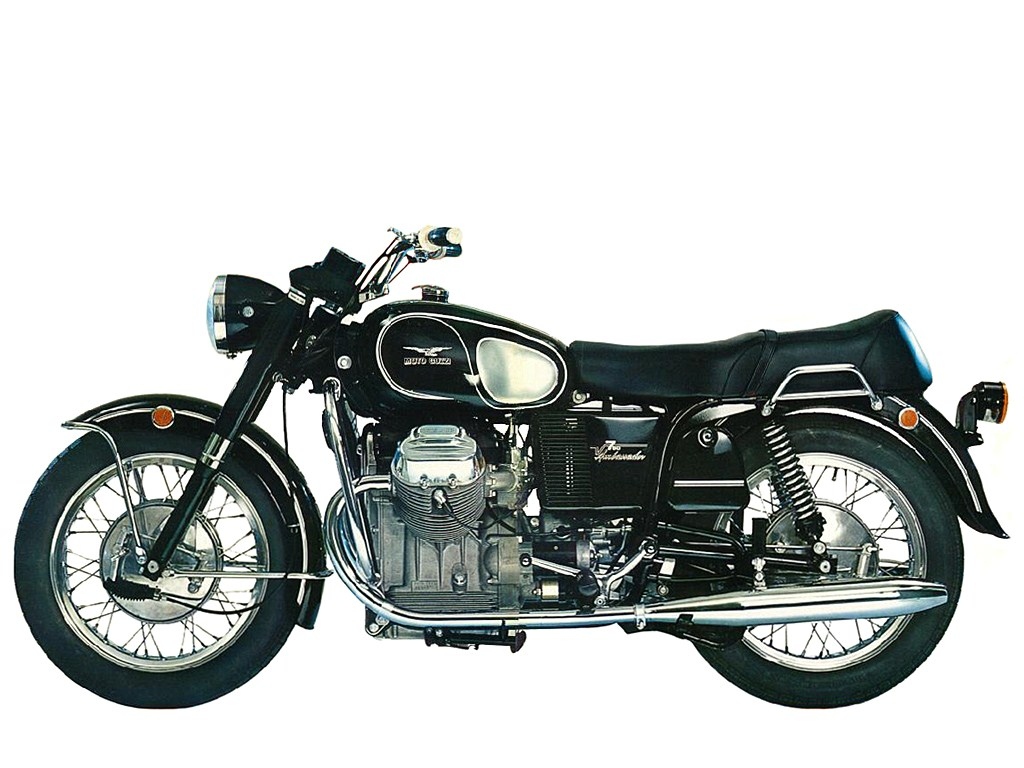
The civilian model
Monday, October 31, 2011

Thursday, October 27, 2011
Chapter 2
A day or so later in the pre-dawn stillness I stood under a street light at the bus stop in my neighborhood. I had a courier bag across my shoulder and a helmet in my hand. The first bus of the day would take me to the train station so I could make my way to the airport in hopes of securing a stand-by passage. Take a bus, catch a train, then hope for a plane. There would be many small journeys to complete before The Big Journey could happen.
Journey-wise, I'd just been in Phoenix--just a few weeks earlier. Dwight, my friend since college, had called me in early September saying he and his wife, April, were in a jam. April had had a family emergency back east, and Dwight, a pilot for Southwest, needed to captain his routes. Could I possibly fly down there and watch the kids.
I'd been laid off since late summer and so had the time to help them out. I'd wanted to return east and once again teach high school but had missed the hiring window as well as the start of the school year. At best, I would be subbing. When Dwight called I was in my storage space, unabashedly breaking my renter's agreement like I did nearly every day by working on my motorcycles there. That day, I was getting ready to hear the long-silent voice of a British parallel twin once again announce its presence to the world. I was also wondering what I was going to do next with my life.
I could go anywhere, do anything, but I had nowhere I really had to be. Ex-content writer, ex-project manager, ex-teacher, ex-soccer coach, ex-soccer player, ex-bike racer. Doors I used to pass through easily were closing or had already closed. However, my sense of fate told me that another was due to open, and when I went through it, I'd be a different person than I was before. A sea-change. I was adrift in the mist of a sea-change. I took a seat in the doorway and let my feet dangle in the afternoon sun while Dwight explained their straits. When he finished, I said, "When do you need me there?" and he said, "Really? Really??" I believe I heard April let out a sigh of relief in the background.
For nearly three weeks they needed me. During that time, I walked the kids to school, packed their lunches, bought groceries, lorded over them during tooth-brush-time, and wiped their milkshakes from the backseat of the car. We'd developed a fierce obsession with aircraft carriers that time, so we built one out of trash bags, spray glue, and a swimming noodle and launched it the backyard swimming pool.
Lullabies, I learned, are mandatory in their world, and I was at a loss because I know almost none. For a while I hummed Christmas carols, but after we watched "The Wizard of Oz," my rendition of Somewhere Over the Rainbow became a nightly request. When I first arrived, Dwight had them calling me Uncle Andy as a joke. By the time I left, they meant it when they said it. "You're family now," April had said.
Shortly after my return to Seattle, I got an email from Dwight. "The kids miss you," he wrote. "We're on to pirate ships now. We are going to the hobby shop soon to get a model of one. Damn you, Uncle Andy."
By this time, I'd been reading Guzziology and was learning my way around the marketplace. I'd just learned about the Las Cruces bike, and it shone far more brightly for me than the loops I was seeing locally. In fact, it shone more brightly than anything else in my life. In my somewhat aimless days while I figured out my next step as an adult, I became aware that I was orienting myself around it.
I wrote him back this message: "I have an idea."
Dwight and I have a history of large scale operations. When I moved out west, he drove the truck with me across the country in a non-stop blistering trip that left us each exhausted for over a week. In light of that marathon, the idea of me flying down there and fixing a forty-year old motorbike in his garage, then riding it half-way across the U.S. seemed easy like Sunday morning.
"Sounds great," he wrote back. Great? Not absurd? That anyone else saw eye-to-eye with me on this matter was scarcely believable. A good friend bails you out of jail, the saying goes, but a better one is in there with you. The buddy pass arrived overnight.
A day before I was to leave, I sent him this email entitled "Gear." Here it is in its entirety.
jacket w liner
pants w liner
boots
gauntlet gloves
full face helmet
neckwarmer
sunglasses I left there.
1 jeans (maybe. for job interview.)
1 shorts
3 shirts
3 sox
3 boxer
1 sweater
1 baselayer bottom
1 baselayer top
mocs.
some sockets and stubby ratchets
multimeter
wire
slot and phillips (will these clear TSA?) [No.]
pliers
crescent wrench
flashlight
Did I forget anything?
The all-weather riding stuff I'd found in the closet of a sublet apartment I'd had for the summer. The kid had sold his Suzuki and left the gear for me because he knew I had a bike. It's not the kind of kit I'd buy, but it is of decent quality and made for touring. And it was free.
To save space, I wore the riding gear. Now waterproof and armored, it was difficult for that not to change how I carried myself. With pockets, pads, and stitching in abundance, and with my black full-face helmet, I looked like a special ops team member traveling to his mission by public transportation. When I noticed anyone looking at me, I'd respond with the slightest of nods while slowly crushing my chewing gum between my far-most molars. Yes, I was conveying. Whatever you're thinking about me and what I'm wearing, the answer, as far as you're concerned, is yes.
On the plane, I looked ready for a high-altitude parachute jump. Metaphorically speaking, that's exactly what it was.
This was happening quickly and I was keeping up. But just. Plans of action were revised for greater efficiency, and if/then contingencies were occurring to me almost to the minute. In the notebook I'd been keeping since discovering Guzzis, at the top of one page, I'd written "Pre-Purchase Check list."
-complete
-straight (frame/forks/rims)
-tank rust
-tires
-stuck
-starts
-runs
-alternator or generator
-compression test
-leak-down test
-chrome cylinders
-last inspected
-last operated
-receipts
-oil color...spark plug color...bearing wobble...petcocks... I was editing the list every few minutes.
This idea of mine, this mission I was finding myself on, differed from how most vintage motorbikes are bought and restored. Usually one has a garage, a shed, or a barn on their permanent residence. (Or at least a storage area.) There, on weekends maybe, the bike gets properly disassembled--parts labeled and fasteners put in zip lock bags -- and one system at a time gets sorted, beginning with the motor, continuing to body work and paint, gauges, the electrics, fuel, suspension, and ending with clutch adjustment or carburetor sync'ing. Thorough jobs mean disassembling and inspecting every nut and bolt, and measuring every spec and tolerance. Only then is the bike reassembled and finally ridden, and then it's usually just a short distance. Final tightenings and torquings need to happen as the machine "settles" before attempting a ride beyond the local zip code.
It's a wonderfully focused process that when completed, removes all mysteries. All the sounds within the running engine have a reason you've touched. And when you hear the noise--of a valve rocker arm, for instance--you see the part in your mind.
In expensive magazines from England, a place where I'm led to believe rusty treasures sit moldering in every garden shed, I read account after account of how retirees restore Ariels, Matchlesses, BSA singles, and Sunbeams in pretty much this way. All very linear. All very tidy. I read and I read and all the narratives are the same in that regard.
My plan, however, was far, far different. I'd revived motorbikes The Right Way, the careful way. What I was planning was more of a crash course. That was the thrill of it.
Soon my list had branched into a three-columned flow chart.
1.) Decide whether to buy the loop, which meant evaluating if it could make it to Seattle without major work. (For some reason, removing and opening the transmission didn't seem "major.")
2.) What I would need to address in order to make it reliable. Cables, carburetor work, fluids, points, plugs, etc.
3.) What I would need to ride it 1400 miles.
The trick was to see all the way from one to three before any money changed hands. The odds of ticking off every item on my ever-growing pre-purchase check lists were slim, and chances are that at some point I would encounter a truly complex problem. I needed for that moment of discovery to happen on paper, where I could consider it for a time. Usually their solutions come to me in the middle of the night and I wake up knowing the answer. That said, the discovery of any big problem had to not happen on the roadside. And definitely not on the roadside at night.
Warnings had been issued.
"Chances are you'll find an Eldo or an Ambo without having to go as far as New Mexico," Dave Richardson had said in his understated way. I read between the lines and knew what he was saying. I pursed my lips and avoided eye contact while he'd said that to me, and so my dream withstood his kind admonishment.
Tony, the parts guy had looked me square in the eye and in all seriousness said, "This is totally sketch."
Of course they're right. Even I would not recommend doing it. But the idea that this could work had me by the imagination, and in theory, the check list could be satisfied. Amidst the dark cautions of the wise, this plan glimmered as if I were viewing it through a pinhole camera. It existed! And it could work! I was seeing it from beginning to end.
The stewardess gave us extra bags of peanuts, which I stashed in the pocket of my pants. For later. In case of an emergency. Such was my thinking at that time.
For a minute I made a sidelong study of the crossword puzzle the passenger next to me was trying to complete. But soon I got back to matters at hand and planned my return route on the cocktail napkin that happened to have printed on it a map of the United States. Phoenix to just outside of Salt Lake City. Salt Lake City to Boise. Boise to Portland. Portland to Seattle. Four days at 350 miles per day. On that teeny-tiny map, the journey didn't seem so big.
As the hours wore on, I became almost totally convinced (convinced!) that this plan would succeed and this trip would happen. Imagine my disappointment, when just a day or so later, it fell apart.
Journey-wise, I'd just been in Phoenix--just a few weeks earlier. Dwight, my friend since college, had called me in early September saying he and his wife, April, were in a jam. April had had a family emergency back east, and Dwight, a pilot for Southwest, needed to captain his routes. Could I possibly fly down there and watch the kids.
I'd been laid off since late summer and so had the time to help them out. I'd wanted to return east and once again teach high school but had missed the hiring window as well as the start of the school year. At best, I would be subbing. When Dwight called I was in my storage space, unabashedly breaking my renter's agreement like I did nearly every day by working on my motorcycles there. That day, I was getting ready to hear the long-silent voice of a British parallel twin once again announce its presence to the world. I was also wondering what I was going to do next with my life.
I could go anywhere, do anything, but I had nowhere I really had to be. Ex-content writer, ex-project manager, ex-teacher, ex-soccer coach, ex-soccer player, ex-bike racer. Doors I used to pass through easily were closing or had already closed. However, my sense of fate told me that another was due to open, and when I went through it, I'd be a different person than I was before. A sea-change. I was adrift in the mist of a sea-change. I took a seat in the doorway and let my feet dangle in the afternoon sun while Dwight explained their straits. When he finished, I said, "When do you need me there?" and he said, "Really? Really??" I believe I heard April let out a sigh of relief in the background.
For nearly three weeks they needed me. During that time, I walked the kids to school, packed their lunches, bought groceries, lorded over them during tooth-brush-time, and wiped their milkshakes from the backseat of the car. We'd developed a fierce obsession with aircraft carriers that time, so we built one out of trash bags, spray glue, and a swimming noodle and launched it the backyard swimming pool.
Lullabies, I learned, are mandatory in their world, and I was at a loss because I know almost none. For a while I hummed Christmas carols, but after we watched "The Wizard of Oz," my rendition of Somewhere Over the Rainbow became a nightly request. When I first arrived, Dwight had them calling me Uncle Andy as a joke. By the time I left, they meant it when they said it. "You're family now," April had said.
Shortly after my return to Seattle, I got an email from Dwight. "The kids miss you," he wrote. "We're on to pirate ships now. We are going to the hobby shop soon to get a model of one. Damn you, Uncle Andy."
By this time, I'd been reading Guzziology and was learning my way around the marketplace. I'd just learned about the Las Cruces bike, and it shone far more brightly for me than the loops I was seeing locally. In fact, it shone more brightly than anything else in my life. In my somewhat aimless days while I figured out my next step as an adult, I became aware that I was orienting myself around it.
I wrote him back this message: "I have an idea."
Dwight and I have a history of large scale operations. When I moved out west, he drove the truck with me across the country in a non-stop blistering trip that left us each exhausted for over a week. In light of that marathon, the idea of me flying down there and fixing a forty-year old motorbike in his garage, then riding it half-way across the U.S. seemed easy like Sunday morning.
"Sounds great," he wrote back. Great? Not absurd? That anyone else saw eye-to-eye with me on this matter was scarcely believable. A good friend bails you out of jail, the saying goes, but a better one is in there with you. The buddy pass arrived overnight.
A day before I was to leave, I sent him this email entitled "Gear." Here it is in its entirety.
jacket w liner
pants w liner
boots
gauntlet gloves
full face helmet
neckwarmer
sunglasses I left there.
1 jeans (maybe. for job interview.)
1 shorts
3 shirts
3 sox
3 boxer
1 sweater
1 baselayer bottom
1 baselayer top
mocs.
some sockets and stubby ratchets
multimeter
wire
slot and phillips (will these clear TSA?) [No.]
pliers
crescent wrench
flashlight
Did I forget anything?
The all-weather riding stuff I'd found in the closet of a sublet apartment I'd had for the summer. The kid had sold his Suzuki and left the gear for me because he knew I had a bike. It's not the kind of kit I'd buy, but it is of decent quality and made for touring. And it was free.
To save space, I wore the riding gear. Now waterproof and armored, it was difficult for that not to change how I carried myself. With pockets, pads, and stitching in abundance, and with my black full-face helmet, I looked like a special ops team member traveling to his mission by public transportation. When I noticed anyone looking at me, I'd respond with the slightest of nods while slowly crushing my chewing gum between my far-most molars. Yes, I was conveying. Whatever you're thinking about me and what I'm wearing, the answer, as far as you're concerned, is yes.
On the plane, I looked ready for a high-altitude parachute jump. Metaphorically speaking, that's exactly what it was.
This was happening quickly and I was keeping up. But just. Plans of action were revised for greater efficiency, and if/then contingencies were occurring to me almost to the minute. In the notebook I'd been keeping since discovering Guzzis, at the top of one page, I'd written "Pre-Purchase Check list."
-complete
-straight (frame/forks/rims)
-tank rust
-tires
-stuck
-starts
-runs
-alternator or generator
-compression test
-leak-down test
-chrome cylinders
-last inspected
-last operated
-receipts
-oil color...spark plug color...bearing wobble...petcocks... I was editing the list every few minutes.
This idea of mine, this mission I was finding myself on, differed from how most vintage motorbikes are bought and restored. Usually one has a garage, a shed, or a barn on their permanent residence. (Or at least a storage area.) There, on weekends maybe, the bike gets properly disassembled--parts labeled and fasteners put in zip lock bags -- and one system at a time gets sorted, beginning with the motor, continuing to body work and paint, gauges, the electrics, fuel, suspension, and ending with clutch adjustment or carburetor sync'ing. Thorough jobs mean disassembling and inspecting every nut and bolt, and measuring every spec and tolerance. Only then is the bike reassembled and finally ridden, and then it's usually just a short distance. Final tightenings and torquings need to happen as the machine "settles" before attempting a ride beyond the local zip code.
It's a wonderfully focused process that when completed, removes all mysteries. All the sounds within the running engine have a reason you've touched. And when you hear the noise--of a valve rocker arm, for instance--you see the part in your mind.
In expensive magazines from England, a place where I'm led to believe rusty treasures sit moldering in every garden shed, I read account after account of how retirees restore Ariels, Matchlesses, BSA singles, and Sunbeams in pretty much this way. All very linear. All very tidy. I read and I read and all the narratives are the same in that regard.
My plan, however, was far, far different. I'd revived motorbikes The Right Way, the careful way. What I was planning was more of a crash course. That was the thrill of it.
Soon my list had branched into a three-columned flow chart.
1.) Decide whether to buy the loop, which meant evaluating if it could make it to Seattle without major work. (For some reason, removing and opening the transmission didn't seem "major.")
2.) What I would need to address in order to make it reliable. Cables, carburetor work, fluids, points, plugs, etc.
3.) What I would need to ride it 1400 miles.
The trick was to see all the way from one to three before any money changed hands. The odds of ticking off every item on my ever-growing pre-purchase check lists were slim, and chances are that at some point I would encounter a truly complex problem. I needed for that moment of discovery to happen on paper, where I could consider it for a time. Usually their solutions come to me in the middle of the night and I wake up knowing the answer. That said, the discovery of any big problem had to not happen on the roadside. And definitely not on the roadside at night.
Warnings had been issued.
"Chances are you'll find an Eldo or an Ambo without having to go as far as New Mexico," Dave Richardson had said in his understated way. I read between the lines and knew what he was saying. I pursed my lips and avoided eye contact while he'd said that to me, and so my dream withstood his kind admonishment.
Tony, the parts guy had looked me square in the eye and in all seriousness said, "This is totally sketch."
Of course they're right. Even I would not recommend doing it. But the idea that this could work had me by the imagination, and in theory, the check list could be satisfied. Amidst the dark cautions of the wise, this plan glimmered as if I were viewing it through a pinhole camera. It existed! And it could work! I was seeing it from beginning to end.
The stewardess gave us extra bags of peanuts, which I stashed in the pocket of my pants. For later. In case of an emergency. Such was my thinking at that time.
For a minute I made a sidelong study of the crossword puzzle the passenger next to me was trying to complete. But soon I got back to matters at hand and planned my return route on the cocktail napkin that happened to have printed on it a map of the United States. Phoenix to just outside of Salt Lake City. Salt Lake City to Boise. Boise to Portland. Portland to Seattle. Four days at 350 miles per day. On that teeny-tiny map, the journey didn't seem so big.
As the hours wore on, I became almost totally convinced (convinced!) that this plan would succeed and this trip would happen. Imagine my disappointment, when just a day or so later, it fell apart.
Wednesday, October 26, 2011
Chapter 3
In retrospect, it took a few days for the plan to change. Time was doing weird things on this trip.
When I arrived at that house I'd so recently left, I noticed the garage had changed. It had always been clean, but now it was extra-spotless. Near his work bench, Dwight had set up power strips and additional tables and lighting. He was as committed to this as I was. He even had a "want list" clip board hanging on the wall.
The kids chorused "Uncle Andy!" to me like the Von Trapp children, and when Nemo, their German Shepherd first saw me, he skittered down the tile hallway, only to reappear a moment later, tail thumping against the drywall as he marched a tight circle. He had one of April's flip flops in his mouth. He was so excited he had to go bite something. The whole household was charged.
The next day we'd go buy a trailer. We'd also go to the hobby shop and buy some paints for the pirate ship model Dwight had already secured. The day after that I'd drive more than five hours across the desert with the windows down, to Las Cruces New Mexico, to proceed with my plan of spending good money on a broken old motorbike while unemployed.
Wyn, the man selling the bike, was putzing in his garage when I finally found my way through the sub-development where he lived. It was mid-afternoon. He was tall, quite thin, and moved slowly. He stood for a second in the doorway when I pulled to the curb, then shuffled towards the back and out of sight.
In the driveway sat a near-spotless red MG convertible that smelled of recent conditioning. It was obvious to me the car was his joy. There was also a newer BMW motorcycle. Like the Guzzi, it, too, was for sale.
If you have any love for them at all, an old motorcycle will take you by the heart the way an old family photograph does. You see or hear it and you start remembering, or coloring something important and real from your past, such as a pot belly stove at your grandparent's house, or your dad, then young and lean, in an undershirt that's perspiration-soaked from his laboring at a task and why don't you ever labor enough to sweat on anything more than a treadmill? Or your older brother and his high school friends laughing in the driveway, or that uncle you've only ever seen a few times. When you were twelve he visited, and everyone stayed at the dinner table after the meal was over and listened to his stories. On his wrist, he wore a leather and turquoise bracelet and had his shirt open one button more than any other adult in your town. He smelled of the outdoors and also of a spice you can't put your finger on, but would love to smell again. Your mom rolled her eyes but still laughed at all of his jokes. You might also think--correctly or not--that you've gotten off track and that your current life isn't as valid as the memories that vintage machine evokes.
Maybe that's one reason people in their forties buy the motorcycles they know from their youth. The bikes represent a mortgageless time of purity and potential. In their middle years, maybe some people need a few hundred cc's of hope. That it goes poTAto-poTAto-poTAto, or burbles, or whirs friendly like a sewing machine when they ask it to, is a bonus.
I do not think I'm off-base in thinking this. "What year is that motorcycle?" the lady at the traffic light shouted as I sat idling my '67 Triumph late this summer, just before I headed to Phoenix for the first time. She was leaning out of her car and shouting across the intersection. There were maybe 10 cars around us. Over the traffic noise I managed a response. "I was in college then," she announced to us all. Then she relaxed against the door sill, her face went all dreamy and she continued,"...it looks like college..." Away she had gone. Right there at the intersection, in her expensive car and tasteful jewelry, she'd left our conversation behind and floated away on the wind of nostalgia. Back to campus. And to freer days, when the Age of Aquarius was about to dawn and had yet to be named. When she'd first said the word "college," her voice was already sounding younger.
These are bikes from the days of leaded gasoline, and the men who have owned them are now old. They're selling them because the very act of breathing is too difficult to permit them a kick start, or they're just too tired from too many seasons to consider a restoration much less a refresh. When we're in their garage or barn, and the bike is sitting--or sagging--between us, I realize that I'm staring not only at an artifact of history, but at an artifact of their history. And both of those histories I respect. I've only bought a few vintage motorcycles, but the significance of the buying-selling moment has stayed with me with me ever since I first found myself in it. I'll fix it, tune it, make it close to how it was, and add a chapter of my own, but all I really am is a caretaker.
The BMW had a dent in the tank from where he'd dropped it. Because of his diabetes, he often loses sensation in his feet so he can't always keep his balance. On the other side of the tank was a second dent from where he'd dropped it while trying to lift it onto its side stand immediately after dropping it the first time. When he told me that, I made sure to compliment him on the MG. He worked at something behind his mustache, then said, "I've had it for 20 years" in such a way that when he finished, I thought he might spit. I learned he was from Oklahoma. From the way he was acting, I got the sense that in Oklahoma, people are raised to hoard any amount of happiness they might have. When I think of his manner, Dust Bowl photography comes to mind.
He had the Guzzi parked where we could walk all around it, which was considerate of him. His daughter had sent me some 30 photos while I was still in Seattle, so I thought I knew what to expect: the bike, vintage hard bags, a windshield, foot boards, running lights. In person, I saw that he'd added a trunk bag to it as well. On the clean-swept floor were arranged in a row these items:
-a set of oversized (950cc) resleeved cylinders and pistons
-a user's manual, (which are much more useful than the ones nowadays. Ones for old bikes actually give detailed instructions on how to set timing, etc.)
-a Premier manual, which is the shop manual for these bikes. (Premier is the importer. They wrote the service manual.)
-a copy of Guzziology.
Considering the overall asking price, it was an attractive spread.
However, the desert sun had oxidized the bike's paint, so instead of black, the tank and fenders were almost as gray as a Persian cat. The red and amber lenses of the turn signals were cataracted with scratches. The dash was scratched from the keys and faded like the fenders. The eagle logo was worn from the tank but the hand pin striping was still there. Mostly. I'd read someone describe these bikes as comfortable like "a favorite pair of old blue jeans." If that's the case, this pair was a little threadbare in places. Because of the broken transmission, the clutch lever was lashed to the handlebar with a bungee cord.
Upon closer inspection, the electricals were running rampant. Near the transmission, wires were undone from a threaded post, yet were clipped together with an alligator clip on a lead whose other end disappeared into the shadowy corners of the chassis. Oh my. Obviously it was a work-around solution. A solution to a problem, but not really a fix. Given the complexity of my plan, I got a sinking feeling about the whole thing. Elsewhere, I saw wires worn through their sheaths, and bunches of others had been braided into a kind of rope. Beneath a gummy spiral of uncoiling electrical tape, I saw how they'd all been soldered together.
That sinking feeling grew, but not necessarily because of the condition of the bike. Rare is the vintage bike that doesn't have questionable fixes dangling in plain sight. They're at least forty years old, which is a lot of time for one prior owner or another to take a shortcut or two when fixing a problem.
No, the sinking feeling was sitting heavy on my diaphragm because the bike needed Work--Work with a capital W. I had imagined a more pristine example, whereas I saw a full tear-down and rebuild in front of me.
Dreams, as they say, die hard. Mine was arrhythmic, but hadn't yet gone into full arrest.
Because internals can have unseeable or unhearable damage, buying a used internal combustion machine is a gamble you can't altogether calculate your way out of. All you can really do is inspect as much of the machine as you can from outside, maybe conduct a compression test or leak-down test, and draw conclusions about how it was treated overall. In the end, you've come up with a list of pros and cons to weigh against each other, but you know the list is incomplete. When all is said and done, you rolls the dice; you takes your chances.
The major weakness of the loops is the cylinders. Originally they were lined with chrome because chrome expands and cools close to the same rate as the metal around it. This allowed for closer tolerances when machining and better overall quality, then say, the iron-to-aluminum relationship between the bores and pistons of other motorcycles.
However, over time, the chrome flakes and falls bit by bit into the engine, where it scores bearings and clogs oil passages until the motor finally fails. (Or "...until the replace engine light come on," one Wild Guzzi member wrote.)
The solution that brings the most peace of mind is to replace both jugs with Nikasil cylinders, a compound of nickel and silicon carbide that's nearly bulletproof. Among others, Mercedes, BMW, Porsche, Ferrari, Maserati, and Chevrolet (ZR-1 Corvette) use them. The manufacturer Moto Guzzi uses for its Nikasil cylinders is Gilardoni, a neighbor of theirs in Lake Como. Every bike has its niggle, but like addressing the crankshaft bearing in Norton's Combat motor, replacing the cylinders of a loop are a must-do. The list of parts for a Gilardoni-Guzzi fix runs into the four figures. Those who learn this fact after buying a used loop recalculate the math of their purchase with a sigh of buyer's remorse.
Wyn had told me he'd had the cylinders redone, so when I knelt and inspected them, near the base of each was stamped Gilardoni, just as it should be. That right there made the asking price a deal. Also, he'd had the crankshaft balanced, and had the receipts for all the work and lists of parts from MG Cycle and Moto International even. The bike had been cared for. It was just tired and well used, was all. The tank chrome was good, which in my experience is somewhat rare. The crash bars were good, too. All the chrome looked good, save some battery acid on the exhaust, but the exhaust was original. My hopes buoyed and my list of pros just gained on my list of cons. But just a little.
The motor turned freely, but when we attempted a jump, there was a failure within the ignition system so it wouldn't even turn over. "It should run," Wyn said.
One rule of buying used motor vehicles is to not pay much at all for one that does not run. Some won't even consider a non-runner to begin with.
Another rule is to buy the nicest example of that model you can find.
So far, Wyn's bike hadn't satisfied either of these rules.
(As far as the second rule goes, I'd seen nicer loops, for sure. I just didn't agree with the pricing. In Seattle, people were asking too much for loops that still had their original bores.)
I had, however, some solutions. I'd been donating two nights a week of my time at a garage in Seattle that funds missionaries and orphanages by reconditioning and selling motorcycles. Because I'd given my time so freely, the owner said they would repaint the Guzzi tank for me and only charge me materials costs. Maybe I could include the fenders also. I had a free donor bike lined up, too.
All of these variable clouded the decision for me. At the end of the afternoon, Wyn's wife was calling to him from the kitchen, counting out the minutes until he had to have his next insulin shot. His energy had faded by then, so he'd taken a seat in a lawn chair at the entrance to the garage while I stood facing the bike, deliberating with folded arms and furrowed brow. He had a stick he was using as a cane and sat holding it like a scepter and staring across the valley. Occasionally he tapped and twisted the tip of it quietly on the floor. For maybe five minutes, that was the only sound in the room.
Before she got too close to zero, I thanked Wyn for all of his time. "This just isn't for me," I said. Disappointment hung in the air between us.
Hours later in the dark, I'd still be a long way from home, heading back to Phoenix in silence because out there in the scrub, the stationless radio scrolled ceaselessly. And that's what you get for chasing a mirage: time in the desert by yourself.
A least we'd build the pirate ship.
Tuesday, October 25, 2011
Chapter 4
Two rules of buying a used motorcycle:
1.) Don't pay much for a non-running machine.
2.) Buy the nicest example you can find and afford.
I'd broken rule #2 before. I'd broken rule #2 before I even knew there were rules. By playing my role in a story that flowed down, down, down, like a creek over a dam, I'd taken a 1963 Honda Superhawk as a gift. Given to me by David, my best friend living then on the family livestock farm, the Honda was bought for $5 from another, older farmer who'd discovered it resting against one of his outbuildings and never bothered to move it out of the elements for 15 years. It seemed fitting that when I took delivery of the Honda, we had to drag it off the back of a double-wheeled pick-up truck in the middle of a snowstorm in the middle of the night.
This was in rural Pennsylvania, in the small town where we'd grown up, where the creek did in fact flow down, down, down, over the dam when we were kids, and where, until a year ago, I was living. The pitted chrome of the Honda's tank tins, the trapped-in-amber, golden-winged tank badges of the early Hondas, and forward-tilted parallel twin motor was old-exotic. Old-traditional was nearly everywhere we looked. Old-exotic was completely new in our eyes.
It was like we'd again become the same restless teenagers we once were; while so much of what was around us was predictably common, the rusty motorcycle he'd spotted, bought with the cash he had in his front pocket, and given to me, promised mysteries.
And mysteries it delivered. Completely seatless, and with the ignition miswired and therefore the harness critically melted, the trailing edge of the front fender crushed and somehow rolled into a spool, fittings rusted, and of course the engine seized. To the uninitiated, the bike was beyond rescue. To the experienced, it would be a labor of love. Certainly it was a violation of rule #2. Free or not, sometimes free is too expensive. In fact, that's the case often.
Eventually, the Honda lay in nearly 200 pieces spread across the ping-pong table in the basement of my mother's house. It was my most thorough disassembly, and by far my most ambitious project yet. Many of the problems I was having with it were all new to me. On the workweek evenings, or on weekends, arriving at a solution delivered a boost that nourished me to--and hopefully through--the next problem I encountered. On and on goes restoration work, one small accomplishment after the next, one fix after the next. It builds towards completion, not at all unlike writing the pages of a novel. It's more of a patience game than it is a knowledge one, I'd say.
The rebuild unfolded over many, many months and became my primary activity outside of my job as a teacher. My students knew about the bike, as did the mechanics at the local foreign car shop, and an old man in my church who wanted to buy the bike when I'd finished. Locals kept asking me if I knew of a man in my mom's neighborhood who was into old motorcycles, but his name always seemed to escape them. At the body shop where I was borrowing a set of dollies and a body panel hammer, or at the auto parts store where I was buying a spool of wire, or the other auto parts store--the one that carried higher quality nuts and bolts--the man's gray hair and mustache were mentioned in detail, but never his name. Everyone but me in the circles I was traveling knew of him, it seemed. The town is small; how was it we hadn't crossed paths before?
Just a decade or so earlier, just about anyone in that small town where the mill used to be could have helped, or pointed me to someone nearby who could. Most men there of a certain generation understood the fundamentals of metal, combustion, and electricity as much as they did what it was to work. When the mill was open, I remember seeing rows of black motorcycles parked in the company lot. The self-reliant element was still there, but the world had changed. Those people were there, now retired, and with kids grown and gone. But still they lived in their modest homes with clean cut lawns they tended themselves and driveways they resealed themselves every summer. Somewhere among those houses, near the chain link fenced-in lot where the rusting train parts sat rusting amongst shocks of weeds, lived the man everyone knew but me.
Then I remembered a detail I'd failed to remember during the many times I'd tried to remember who this man might be. The brain puzzles me how it works like that. There I was, wondering at the workbench because I was balking over reinstalling the camshaft, and thinking of who might be of help. All at once I just knew where to go.
The image arrived like a phone call: a pickup truck parked at a curb where I'd never noticed it before. Strapped in place, upright in the bed of the truck, a dingy Norton Commando stood proud. At the time, I had no idea what it was, but I noticed it because though a shadow of what it once was, it had the solid stance and confidently-drawn lines of something special. Over a year earlier I'd seen it. And it was just down the street. How had I not remembered that?
The next day after grading a few papers after school, I'd walked over to the house where I'd seen the truck. When I climbed the steps to knock on his door, his wife answered. I said hi and told her my name, where I lived, and that I liked old motorcycles. I concluded by saying, "I think your husband and I need to meet."
She stood in the doorway wiping her hands. "Well, his name is Jim. But everyone calls him Patch."
I wasn't sure I'd heard her right. We traded blinks at the fact she'd just called him, a grown man, Patch. But Patch it was.
As it turned out, Patch had owned the same Honda I was in the midst of. He'd bought it in college, against his father's wishes. And because riding a motorcycle is a drug you either enjoy or reject, the first one sometimes leads to the rapid or eventual ownership of another motorcycle. Or else owning that first one doesn't lead to another, ever. The Honda was soon gone. Patch had traded up to an early Harley Sportster he'd bought with all his money from a student on campus who was intimidated by its size and power.
After college, the Harley languished under dust and within its own turpentine deposits for years in the barns and garages of friends while Patch served in Vietnam, then went to flight school for Delta airlines, then gotten on with his life as a pilot and a husband. Many of the men who stop me at gas stations say, I haven't seen one of those in 30 years because they too have gotten on with their lives. Any chance you want to sell it? they sometimes add. They've gotten on with their lives like Patch had: one motorcycle too soon.
The forgotten dream that was the slumbering giant awoke suddenly when Patch was over 50 years old, and in San Fransisco between flights. It was morning and he was jogging in The Presidio when he heard the burble of the Triumph exhaust note from just up the road. The Triumph was the sound from his youth, the sound that called to many.
The man on the Triumph had pulled to the curb to admire the view of the bay, the way you should if you have a Triumph, so Patch was able to catch up to him. A life-changing stream of information followed. Is this really one of the old ones? How did you find the parts to restore this? And it doesn't cost a lot? And you can still find the bikes? It turned out, you could find them. And over the course of the next few years, when examples of British iron were still complete and somewhat cheap, Patch did find them.
The day Patch lit the torch I was carrying was the day I stood in his bunker-like garage while he fired up his BSA Thunderbolt. Because British bikes until 1975 were kickstart-only, starting one means you never hear the whine of a starter motor. Instead, they go from near-silence to sudden roar, and in that garage I thought it was going to explode. When it settled to idle, the exhaust note through the pea-shooter mufflers was full and meaningful. The overhead light in the otherwise dim garage reflected the highlights of the chromed tank, the handlebar, the rims. It was a gorgeous piece of history, and it sounded earnest and capable. Right then and there, I'd heard all I needed to.
The Superhawk has become one of the most sought after of the early Hondas, but Patch was right: next to the British bikes, it's a thin-walled tin toy. We'd become acquaintances while I worked my way through it, and friends-as-equals when his wife's illness consumed her. During those difficult months, I'd put on the coffee pot so we'd have something to drink when he came over in the evenings and we pretended to work. Sometimes we never even made it to the workbench. We just stood in the kitchen and I listened to him talk.
The summer in the midst of all of that, he guided my purchasing of a 1970 Triumph, the last of the 60s styled 650s. On those evenings in the garage, I often held the trouble light while he bent or squatted near some fitting with a Whitworth wrench. I let him do the bulk of the work because at over sixty years old, he was as excited as I was. The evenings were warm but not hot, the garage door was open into the darkness, and the town was quiet enough to hear the moths flittering about the garage doorway. I was enjoying the moment enough.
It took weeks to revive the Triumph, but the night it was ready, we ushered my mom off of the couch and into the garage where we helped her into a folding lawn chair safely out of the way. When I kicked it to roaring life for the first time in 30 years, the vibrations made it skitter across the floor on its center stand. I'd never seen a bike do that before. It was as terrifying a sight as it was wonderful. My mom clapped her hands together and rolled her head back as if about to take a dramatic bow. "I haven't heard that sound for a long time," she said. Then she shook her head slowly and looked from the bike to me. "Oohh, It takes me back." I tried to play it off as pure fun, but I think the rescue and revival of that old machine was a moment come full circle for everyone present.
***
I trust Patch with anything, and that includes understanding my disappointment over the Guzzi dream evaporating. Just after leaving Wyn's, at the edge of Las Cruces, I called him from a gas station.
I sighed. "I didn't buy it."
"Good!" Patch has the quiet voice of a gentle man. At this, though, he was adamant enough that he almost barked. "It would have taken you two years to sort it all out." Then, in the tones he usually uses, he said, "You did the right thing."
He was right. Patch has lived enough to advocate a slower, more considerate pace to living than I sometimes take. With Patch, there's nothing wrong with having yourself a good wait. Good things come to he who waits. The solution emerges in its own time. Like drawing maple syrup from a tree on your own land, or sharpening a fifty year-old knife with a fifty-year old file because the steel in both is better than what you can find today, his way is the way you can be proud of. This all sounds like a cliche of what it is to be of a certain American generation that's now cool and pure to emulate, but so many will find so much of it so unfashionable, and slow, plain, and annoyingly thrifty, that I doubt his ways will catch on again.
But I get it. Like me, he was a late bloomer and it took some time for him to find his way in the world. It's because of the experiences he's shared that in the lean times I'm in the thick of these days, I get by with less and don't lapse into self-pity. I have enough of what I need to get by and it'll be okay. I oil my boots and they keep on walking. I'm across the country from that small town and I never suspected that distance would make a difference, but to my surprise it does. I call and we talk maybe once a week and so I keep faith in my sense of integrity. His real name is Jim, but the nickname Patch, given to him by his dad when he was just a boy, works on so many levels. To call him Jim would be weird.
Yes, Patch was right about the Guzzi. He was right and I knew it. Further, he was right and he knew that I knew it. He'd taught me the rules of buying used motorcycles, after all.
When we'd finished talking about the bike, he continued, "The weather's starting to turn here. It's almost time to drain the oil and bring the bikes in."
Reflexively, I pictured Pennsylvania in early fall. I imagined the afternoon sun, lower in the sky and therefore gently-spotty through the trees, and the sweet smell of leaves. In my mind I saw the evening color and the settling chill it brought. Imagining isn't really the correct word for how I see my home state. In my mind it just was--as much as my DNA just is.
Of his stable of eight or so vintage motorcycles, the ones he rides regularly he keeps in his garage. He'd wheel into the basement the ones that needed winter time work. From 2800 hundred miles away, I knew the catalog of work the each bike needed because we talked about work. The forks on the BSA Thunderbolt had a clunk. That would be first up. The clutch cable dragged on the Lightning. The Triumph needed reassembled and then it would be simply stunning. The Matchless needed a top end rebuild and a new muffler, at the very least. His hands would be cold from the weather and therefore it would smart that little bit extra if he caught his knuckle on the door jamb as he walked one of the bikes through. I smiled because it's weather I used to know. I smiled, because above all, it's familiar.
He also has that Commando, the one from the back of his pick-up truck half a dozen hears ago. It periodically and suddenly loses all power, and I'm convinced it's the ignition switch. During that call I wanted to pack a moving truck and be there in a week to help fix them all. And in the spring, ride the old roads from on board the old motors, to the old diners, to the Secret Motorcycle Shop, to the Barbershop Motorcycle Shop, to The Family Tradition, and to all the other old haunts. Then to the BSA rallies. And with fingers crossed, maybe even all the way to Mid Ohio. Or to the Triumph rally, the one aptly named Triumph Come Home.
In the midst of those daydreams of roads I already knew, the Guzzi dream remained a disappointment and in some ways a failure. I saw it as a challenge I did not rise to meet at a time when I needed a challenge I could meet.
***
There are two additional rules in buying a used motorcycle.
3.) Only buy a complete or nearly complete bike. Definitely make sure it has all the tinware. (Fenders, tank, side covers.)
4.) Buy when the price it right. And only buy when the price is right.
While Wyn's bike didn't meet rules 1 and 2, it easily met 3 and 4. On the way home, I balanced and rebalanced the equation whose variables were Nikasil, receipts, original. To those I added weather beaten, wiring, transmission, non-running, asking price, distance if I had to ship it, cost of a new transmission if I couldn't fix it.
At the tail end of my journey, just outside of Tucson, I stopped at another gas station. At the pump next to mine sat a tan Honda Goldwing from the 80s. Like all Goldwings, it was fully loaded for long distance riding. Ours were the only two vehicles in the bays. I looked across to the storefront and saw a man sipping coffee at the window.
I never got his name, and I can't remember what I asked to get the conversation started. Probably my old stand-by, How do you like the bike? I'd gone inside for a sandwich because I knew it was late enough that Dwight and his family would all be asleep when I got home. He was just leaving, so we walked back to the pumps together.
I could tell from the tempo of our conversation that it was just going to be a minute-long exchange then we'd part company forever. However, when I told him of my plan to buy the Moto Guzzi, fix it, then ride it to Seattle, he stopped his preparations in the bike's truck box and his whole manner changed. He ambled around to my side of the Wing, then crossed his legs and leaned against it like he was standing at a bar and had turned to survey the crowd behind him. (Gold Wings are that substantial.) Hand on his hip, and coat pushed back, out of the way, he was settling in for a talk. Late forties and stubbly, though recently clean cut, he looked white collar. And he was friendly enough to laugh at his own stories. He reminded me those plywood cutouts of silhouetted hobos people set against trees in their front yard.
He was from Florida. He'd left a week earlier. His sister had just mailed him some money in Phoenix so he could get something to eat. Why he didn't have money, or access to money, I have no idea, and I'm sure it's not an upbeat story. However, people ride motorcycles long distances for all kinds of reasons. I'd read Neal Peart's Ghost Rider: Travels on the Healing Road, so I reserved judgment and just enjoyed the talk. He told me about running out of gas, of taking a short cut across the scrub and bottoming the bike out on the rim of a ditch he'd tried to ride over, then having to hold the bike up for nearly half an hour until a pair of hikers showed up and helped him get it clear, just as he was about to give up and drop it. He talked about catching showers at truckstops and napping where he could when he needed a break. With all of this he seemed fine, if not happy. He was having a time of it.
He was wearing jeans and boots and a bomber jacket, not quite proper highway motorcycle attire. When he got his helmet out of the trunk box, I saw that it was in fact a little league batting helmet. It didn't even have a chin strap. He reminded me of Jack Nicholson's character in Easy Rider.
He dug in his pocket for a few seconds, and then bent to one knee down near the starter solenoid. It had failed, so the only way to start the bike was to hot wire it. I think he used one of those bottle openers people carry on their key chains. Whatever it was, after a few flashes of sparks between the solenoid's terminals, the Honda puttered to life. I had to smile at that. Half a minute later, he rolled out, not exactly an expert on the bike, but not a beginner either.
Ten minutes down the road, I saw his running lights in the distance amidst the other traffic. Like small semi trucks those Gold Wings are. As I approached and passed, I saw that his posture never changed; he never turned to check his mirrors. He just sat tall in his batting helmet, cruising comfortably at 75 in the center lane, maybe lost in thought. I think he said he was headed to California, then up the coast. I wish him luck.
Whenever I see misfits like that on bikes I wonder if I'm not seeing my own personal Ghost of Motorcycling Future. Will I wind up completely trading the engaged world of middle-class America for the one of my own pursuits? Will I be the guy with the encyclopedic knowledge of moto-esoterica and rusty social skills? Will I be that guy wandering the highways during his middle years?
And then I think, so what if I become that guy. Those types harbor no quiet desperation in their lives, as far as I can tell. They seem to have followed their bliss. The Guzzi Adventure promised knowledge I wanted to have, a problem I wanted to solve, a bliss I wanted to follow.
The next morning I slept until 8 a.m., so when I walked into the kitchen, Dwight and his family were already at the table eating sliced fruit and having coffee and juice. Before leaving Las Cruces, I'd texted him this message: "Bike needs too much work. Not the time or place for it." He'd replied, "Take as much time as you need."
Between discussing with the kids the pirate ship we would build, I explained to Dwight and April the details of why I hadn't bought it. My disappointment in myself was evident in my posture alone, I'm sure. Dwight repeated, "Take as much time as you need to fix it. We've got the room." April seemed to feel the same way.
We all talked some more and had our meal. During this time, the thought of it hung in the back of my mind. While washing my coffee mug in the sink, with eyebrows arched in growing excitement, I said to them, "If that's the case, if that's the case, then I'm going to buy it."
The statement was a complete non sequitur to the topic we'd evolved to in our conversation, but Dwight looked to me as soon as I said it. It was as though he too had kept the thread running in his head while we all had talked of pirate ships and dog walks. I felt my self-respect rise the moment I'd said it because adventure had come knockin' and I'd found what I believed was the courage to open the door. Dwight seemed happier too. Adventure was dwelling amongst us again.
I called Wyn soon after and left a message saying that I'd thought it over, and if the motorcycle was still available, I'd like to buy it. That afternoon, my phone rang and I recognized the number as Wyn's. Dwight and the kids were reading a book, but he and I made knowing eye contact as I disappeared into his office to take the call.
Two minutes later I emerged with that gleam in my eye people tell me I get when I talk about the things I am passionate about. I was practically en pointe. Dwight looked up to get the news. In response, and I chewed my gum that much louder from behind my crooked smile. There was no need for words.
"When do you leave?"
"Tomorrow morning. 6 a.m."
Dwight smiled. "You're insane."
"Oh, I'm in the thick of it now!" I roared. Slumbering Nemo swung his head my way in surprise and the kids took their cue and immediately tried to outshout each other. I have no idea what they were saying, but they were shouting it.
From here on out I didn't care if I failed. I was about to break a few of the rules, and maybe lose a few bucks, but not trying this bothered me more. I hoped Patch would understand my folly.
1.) Don't pay much for a non-running machine.
2.) Buy the nicest example you can find and afford.
I'd broken rule #2 before. I'd broken rule #2 before I even knew there were rules. By playing my role in a story that flowed down, down, down, like a creek over a dam, I'd taken a 1963 Honda Superhawk as a gift. Given to me by David, my best friend living then on the family livestock farm, the Honda was bought for $5 from another, older farmer who'd discovered it resting against one of his outbuildings and never bothered to move it out of the elements for 15 years. It seemed fitting that when I took delivery of the Honda, we had to drag it off the back of a double-wheeled pick-up truck in the middle of a snowstorm in the middle of the night.
This was in rural Pennsylvania, in the small town where we'd grown up, where the creek did in fact flow down, down, down, over the dam when we were kids, and where, until a year ago, I was living. The pitted chrome of the Honda's tank tins, the trapped-in-amber, golden-winged tank badges of the early Hondas, and forward-tilted parallel twin motor was old-exotic. Old-traditional was nearly everywhere we looked. Old-exotic was completely new in our eyes.
It was like we'd again become the same restless teenagers we once were; while so much of what was around us was predictably common, the rusty motorcycle he'd spotted, bought with the cash he had in his front pocket, and given to me, promised mysteries.
And mysteries it delivered. Completely seatless, and with the ignition miswired and therefore the harness critically melted, the trailing edge of the front fender crushed and somehow rolled into a spool, fittings rusted, and of course the engine seized. To the uninitiated, the bike was beyond rescue. To the experienced, it would be a labor of love. Certainly it was a violation of rule #2. Free or not, sometimes free is too expensive. In fact, that's the case often.
Eventually, the Honda lay in nearly 200 pieces spread across the ping-pong table in the basement of my mother's house. It was my most thorough disassembly, and by far my most ambitious project yet. Many of the problems I was having with it were all new to me. On the workweek evenings, or on weekends, arriving at a solution delivered a boost that nourished me to--and hopefully through--the next problem I encountered. On and on goes restoration work, one small accomplishment after the next, one fix after the next. It builds towards completion, not at all unlike writing the pages of a novel. It's more of a patience game than it is a knowledge one, I'd say.
The rebuild unfolded over many, many months and became my primary activity outside of my job as a teacher. My students knew about the bike, as did the mechanics at the local foreign car shop, and an old man in my church who wanted to buy the bike when I'd finished. Locals kept asking me if I knew of a man in my mom's neighborhood who was into old motorcycles, but his name always seemed to escape them. At the body shop where I was borrowing a set of dollies and a body panel hammer, or at the auto parts store where I was buying a spool of wire, or the other auto parts store--the one that carried higher quality nuts and bolts--the man's gray hair and mustache were mentioned in detail, but never his name. Everyone but me in the circles I was traveling knew of him, it seemed. The town is small; how was it we hadn't crossed paths before?
Just a decade or so earlier, just about anyone in that small town where the mill used to be could have helped, or pointed me to someone nearby who could. Most men there of a certain generation understood the fundamentals of metal, combustion, and electricity as much as they did what it was to work. When the mill was open, I remember seeing rows of black motorcycles parked in the company lot. The self-reliant element was still there, but the world had changed. Those people were there, now retired, and with kids grown and gone. But still they lived in their modest homes with clean cut lawns they tended themselves and driveways they resealed themselves every summer. Somewhere among those houses, near the chain link fenced-in lot where the rusting train parts sat rusting amongst shocks of weeds, lived the man everyone knew but me.
Then I remembered a detail I'd failed to remember during the many times I'd tried to remember who this man might be. The brain puzzles me how it works like that. There I was, wondering at the workbench because I was balking over reinstalling the camshaft, and thinking of who might be of help. All at once I just knew where to go.
The image arrived like a phone call: a pickup truck parked at a curb where I'd never noticed it before. Strapped in place, upright in the bed of the truck, a dingy Norton Commando stood proud. At the time, I had no idea what it was, but I noticed it because though a shadow of what it once was, it had the solid stance and confidently-drawn lines of something special. Over a year earlier I'd seen it. And it was just down the street. How had I not remembered that?
The next day after grading a few papers after school, I'd walked over to the house where I'd seen the truck. When I climbed the steps to knock on his door, his wife answered. I said hi and told her my name, where I lived, and that I liked old motorcycles. I concluded by saying, "I think your husband and I need to meet."
She stood in the doorway wiping her hands. "Well, his name is Jim. But everyone calls him Patch."
I wasn't sure I'd heard her right. We traded blinks at the fact she'd just called him, a grown man, Patch. But Patch it was.
As it turned out, Patch had owned the same Honda I was in the midst of. He'd bought it in college, against his father's wishes. And because riding a motorcycle is a drug you either enjoy or reject, the first one sometimes leads to the rapid or eventual ownership of another motorcycle. Or else owning that first one doesn't lead to another, ever. The Honda was soon gone. Patch had traded up to an early Harley Sportster he'd bought with all his money from a student on campus who was intimidated by its size and power.
After college, the Harley languished under dust and within its own turpentine deposits for years in the barns and garages of friends while Patch served in Vietnam, then went to flight school for Delta airlines, then gotten on with his life as a pilot and a husband. Many of the men who stop me at gas stations say, I haven't seen one of those in 30 years because they too have gotten on with their lives. Any chance you want to sell it? they sometimes add. They've gotten on with their lives like Patch had: one motorcycle too soon.
The forgotten dream that was the slumbering giant awoke suddenly when Patch was over 50 years old, and in San Fransisco between flights. It was morning and he was jogging in The Presidio when he heard the burble of the Triumph exhaust note from just up the road. The Triumph was the sound from his youth, the sound that called to many.
The man on the Triumph had pulled to the curb to admire the view of the bay, the way you should if you have a Triumph, so Patch was able to catch up to him. A life-changing stream of information followed. Is this really one of the old ones? How did you find the parts to restore this? And it doesn't cost a lot? And you can still find the bikes? It turned out, you could find them. And over the course of the next few years, when examples of British iron were still complete and somewhat cheap, Patch did find them.
The day Patch lit the torch I was carrying was the day I stood in his bunker-like garage while he fired up his BSA Thunderbolt. Because British bikes until 1975 were kickstart-only, starting one means you never hear the whine of a starter motor. Instead, they go from near-silence to sudden roar, and in that garage I thought it was going to explode. When it settled to idle, the exhaust note through the pea-shooter mufflers was full and meaningful. The overhead light in the otherwise dim garage reflected the highlights of the chromed tank, the handlebar, the rims. It was a gorgeous piece of history, and it sounded earnest and capable. Right then and there, I'd heard all I needed to.
The Superhawk has become one of the most sought after of the early Hondas, but Patch was right: next to the British bikes, it's a thin-walled tin toy. We'd become acquaintances while I worked my way through it, and friends-as-equals when his wife's illness consumed her. During those difficult months, I'd put on the coffee pot so we'd have something to drink when he came over in the evenings and we pretended to work. Sometimes we never even made it to the workbench. We just stood in the kitchen and I listened to him talk.
The summer in the midst of all of that, he guided my purchasing of a 1970 Triumph, the last of the 60s styled 650s. On those evenings in the garage, I often held the trouble light while he bent or squatted near some fitting with a Whitworth wrench. I let him do the bulk of the work because at over sixty years old, he was as excited as I was. The evenings were warm but not hot, the garage door was open into the darkness, and the town was quiet enough to hear the moths flittering about the garage doorway. I was enjoying the moment enough.
It took weeks to revive the Triumph, but the night it was ready, we ushered my mom off of the couch and into the garage where we helped her into a folding lawn chair safely out of the way. When I kicked it to roaring life for the first time in 30 years, the vibrations made it skitter across the floor on its center stand. I'd never seen a bike do that before. It was as terrifying a sight as it was wonderful. My mom clapped her hands together and rolled her head back as if about to take a dramatic bow. "I haven't heard that sound for a long time," she said. Then she shook her head slowly and looked from the bike to me. "Oohh, It takes me back." I tried to play it off as pure fun, but I think the rescue and revival of that old machine was a moment come full circle for everyone present.
***
I trust Patch with anything, and that includes understanding my disappointment over the Guzzi dream evaporating. Just after leaving Wyn's, at the edge of Las Cruces, I called him from a gas station.
I sighed. "I didn't buy it."
"Good!" Patch has the quiet voice of a gentle man. At this, though, he was adamant enough that he almost barked. "It would have taken you two years to sort it all out." Then, in the tones he usually uses, he said, "You did the right thing."
He was right. Patch has lived enough to advocate a slower, more considerate pace to living than I sometimes take. With Patch, there's nothing wrong with having yourself a good wait. Good things come to he who waits. The solution emerges in its own time. Like drawing maple syrup from a tree on your own land, or sharpening a fifty year-old knife with a fifty-year old file because the steel in both is better than what you can find today, his way is the way you can be proud of. This all sounds like a cliche of what it is to be of a certain American generation that's now cool and pure to emulate, but so many will find so much of it so unfashionable, and slow, plain, and annoyingly thrifty, that I doubt his ways will catch on again.
But I get it. Like me, he was a late bloomer and it took some time for him to find his way in the world. It's because of the experiences he's shared that in the lean times I'm in the thick of these days, I get by with less and don't lapse into self-pity. I have enough of what I need to get by and it'll be okay. I oil my boots and they keep on walking. I'm across the country from that small town and I never suspected that distance would make a difference, but to my surprise it does. I call and we talk maybe once a week and so I keep faith in my sense of integrity. His real name is Jim, but the nickname Patch, given to him by his dad when he was just a boy, works on so many levels. To call him Jim would be weird.
Yes, Patch was right about the Guzzi. He was right and I knew it. Further, he was right and he knew that I knew it. He'd taught me the rules of buying used motorcycles, after all.
When we'd finished talking about the bike, he continued, "The weather's starting to turn here. It's almost time to drain the oil and bring the bikes in."
Reflexively, I pictured Pennsylvania in early fall. I imagined the afternoon sun, lower in the sky and therefore gently-spotty through the trees, and the sweet smell of leaves. In my mind I saw the evening color and the settling chill it brought. Imagining isn't really the correct word for how I see my home state. In my mind it just was--as much as my DNA just is.
Of his stable of eight or so vintage motorcycles, the ones he rides regularly he keeps in his garage. He'd wheel into the basement the ones that needed winter time work. From 2800 hundred miles away, I knew the catalog of work the each bike needed because we talked about work. The forks on the BSA Thunderbolt had a clunk. That would be first up. The clutch cable dragged on the Lightning. The Triumph needed reassembled and then it would be simply stunning. The Matchless needed a top end rebuild and a new muffler, at the very least. His hands would be cold from the weather and therefore it would smart that little bit extra if he caught his knuckle on the door jamb as he walked one of the bikes through. I smiled because it's weather I used to know. I smiled, because above all, it's familiar.
He also has that Commando, the one from the back of his pick-up truck half a dozen hears ago. It periodically and suddenly loses all power, and I'm convinced it's the ignition switch. During that call I wanted to pack a moving truck and be there in a week to help fix them all. And in the spring, ride the old roads from on board the old motors, to the old diners, to the Secret Motorcycle Shop, to the Barbershop Motorcycle Shop, to The Family Tradition, and to all the other old haunts. Then to the BSA rallies. And with fingers crossed, maybe even all the way to Mid Ohio. Or to the Triumph rally, the one aptly named Triumph Come Home.
In the midst of those daydreams of roads I already knew, the Guzzi dream remained a disappointment and in some ways a failure. I saw it as a challenge I did not rise to meet at a time when I needed a challenge I could meet.
***
There are two additional rules in buying a used motorcycle.
3.) Only buy a complete or nearly complete bike. Definitely make sure it has all the tinware. (Fenders, tank, side covers.)
4.) Buy when the price it right. And only buy when the price is right.
While Wyn's bike didn't meet rules 1 and 2, it easily met 3 and 4. On the way home, I balanced and rebalanced the equation whose variables were Nikasil, receipts, original. To those I added weather beaten, wiring, transmission, non-running, asking price, distance if I had to ship it, cost of a new transmission if I couldn't fix it.
At the tail end of my journey, just outside of Tucson, I stopped at another gas station. At the pump next to mine sat a tan Honda Goldwing from the 80s. Like all Goldwings, it was fully loaded for long distance riding. Ours were the only two vehicles in the bays. I looked across to the storefront and saw a man sipping coffee at the window.
I never got his name, and I can't remember what I asked to get the conversation started. Probably my old stand-by, How do you like the bike? I'd gone inside for a sandwich because I knew it was late enough that Dwight and his family would all be asleep when I got home. He was just leaving, so we walked back to the pumps together.
I could tell from the tempo of our conversation that it was just going to be a minute-long exchange then we'd part company forever. However, when I told him of my plan to buy the Moto Guzzi, fix it, then ride it to Seattle, he stopped his preparations in the bike's truck box and his whole manner changed. He ambled around to my side of the Wing, then crossed his legs and leaned against it like he was standing at a bar and had turned to survey the crowd behind him. (Gold Wings are that substantial.) Hand on his hip, and coat pushed back, out of the way, he was settling in for a talk. Late forties and stubbly, though recently clean cut, he looked white collar. And he was friendly enough to laugh at his own stories. He reminded me those plywood cutouts of silhouetted hobos people set against trees in their front yard.
He was from Florida. He'd left a week earlier. His sister had just mailed him some money in Phoenix so he could get something to eat. Why he didn't have money, or access to money, I have no idea, and I'm sure it's not an upbeat story. However, people ride motorcycles long distances for all kinds of reasons. I'd read Neal Peart's Ghost Rider: Travels on the Healing Road, so I reserved judgment and just enjoyed the talk. He told me about running out of gas, of taking a short cut across the scrub and bottoming the bike out on the rim of a ditch he'd tried to ride over, then having to hold the bike up for nearly half an hour until a pair of hikers showed up and helped him get it clear, just as he was about to give up and drop it. He talked about catching showers at truckstops and napping where he could when he needed a break. With all of this he seemed fine, if not happy. He was having a time of it.
He was wearing jeans and boots and a bomber jacket, not quite proper highway motorcycle attire. When he got his helmet out of the trunk box, I saw that it was in fact a little league batting helmet. It didn't even have a chin strap. He reminded me of Jack Nicholson's character in Easy Rider.
He dug in his pocket for a few seconds, and then bent to one knee down near the starter solenoid. It had failed, so the only way to start the bike was to hot wire it. I think he used one of those bottle openers people carry on their key chains. Whatever it was, after a few flashes of sparks between the solenoid's terminals, the Honda puttered to life. I had to smile at that. Half a minute later, he rolled out, not exactly an expert on the bike, but not a beginner either.
Ten minutes down the road, I saw his running lights in the distance amidst the other traffic. Like small semi trucks those Gold Wings are. As I approached and passed, I saw that his posture never changed; he never turned to check his mirrors. He just sat tall in his batting helmet, cruising comfortably at 75 in the center lane, maybe lost in thought. I think he said he was headed to California, then up the coast. I wish him luck.
Whenever I see misfits like that on bikes I wonder if I'm not seeing my own personal Ghost of Motorcycling Future. Will I wind up completely trading the engaged world of middle-class America for the one of my own pursuits? Will I be the guy with the encyclopedic knowledge of moto-esoterica and rusty social skills? Will I be that guy wandering the highways during his middle years?
And then I think, so what if I become that guy. Those types harbor no quiet desperation in their lives, as far as I can tell. They seem to have followed their bliss. The Guzzi Adventure promised knowledge I wanted to have, a problem I wanted to solve, a bliss I wanted to follow.
The next morning I slept until 8 a.m., so when I walked into the kitchen, Dwight and his family were already at the table eating sliced fruit and having coffee and juice. Before leaving Las Cruces, I'd texted him this message: "Bike needs too much work. Not the time or place for it." He'd replied, "Take as much time as you need."
Between discussing with the kids the pirate ship we would build, I explained to Dwight and April the details of why I hadn't bought it. My disappointment in myself was evident in my posture alone, I'm sure. Dwight repeated, "Take as much time as you need to fix it. We've got the room." April seemed to feel the same way.
We all talked some more and had our meal. During this time, the thought of it hung in the back of my mind. While washing my coffee mug in the sink, with eyebrows arched in growing excitement, I said to them, "If that's the case, if that's the case, then I'm going to buy it."
The statement was a complete non sequitur to the topic we'd evolved to in our conversation, but Dwight looked to me as soon as I said it. It was as though he too had kept the thread running in his head while we all had talked of pirate ships and dog walks. I felt my self-respect rise the moment I'd said it because adventure had come knockin' and I'd found what I believed was the courage to open the door. Dwight seemed happier too. Adventure was dwelling amongst us again.
I called Wyn soon after and left a message saying that I'd thought it over, and if the motorcycle was still available, I'd like to buy it. That afternoon, my phone rang and I recognized the number as Wyn's. Dwight and the kids were reading a book, but he and I made knowing eye contact as I disappeared into his office to take the call.
Two minutes later I emerged with that gleam in my eye people tell me I get when I talk about the things I am passionate about. I was practically en pointe. Dwight looked up to get the news. In response, and I chewed my gum that much louder from behind my crooked smile. There was no need for words.
"When do you leave?"
"Tomorrow morning. 6 a.m."
Dwight smiled. "You're insane."
"Oh, I'm in the thick of it now!" I roared. Slumbering Nemo swung his head my way in surprise and the kids took their cue and immediately tried to outshout each other. I have no idea what they were saying, but they were shouting it.
From here on out I didn't care if I failed. I was about to break a few of the rules, and maybe lose a few bucks, but not trying this bothered me more. I hoped Patch would understand my folly.
Monday, October 24, 2011
Chapter 5
A few minutes after arriving at Wyn's for the second time in three days, he asked, "How long of a drive is it from Phoenix to here?"
"Six hours," I replied.
Without batting an eye, he said, "You could have saved yourself some trouble and just bought it the first time."
But he didn't say that. In fact, if Wyn had an opinion of me making that all-day drive for the second time in three days, he didn't share it. He was stingy with his words, and so seldom said more than one sentence at a turn. I had expected him to surrender a few choice ones at my expense. Whatever he was thinking, he kept it inside.
In Wyn's world, as far as I could tell time moved slower than it did anywhere else. All was as it was the first time I was there: the sky and the dusty sunlight of the garage air, the Guzzi on its stand in the recesses, Wyn's deliberate, fragile movements,and long moments of silence. Even his clothes were drab and earth colored. The fact that I'd driven an additional 12 hours made no difference in how he addressed me. In fact, he barely addressed me at all.
There was very little sense in reexamining the Guzzi. I was there to buy it and that was that. I'd committed to the gamble. When the time came for him to sign the back of the title and me to hand him a stack of hundreds, I said, "By driving back here, I lost my bargaining power." To that, he worked a nonexistent chaw of tobacco and drawled, "Pretty much." The atmosphere was of a place where Wyn had witnessed much over the years. Surprise for him was all but impossible.
On the contrary, by the time I left, I would be the one surprised.
We needed his wife to help us load the bike onto the trailer. Until then, she'd only been a voice from the kitchen and the smell of cigarette smoke. She shooed the poodles to her heels as she closed the screen door. She wore a pastel blue top, capri-like pants made of white linen, and brown sandles. Wyn did not introduce us so she approached unsmiling and said nothing.
Because the Guzzi weighs well over 500 pounds, and had so many accessories on it, pushing it up the ramp was a cumbersome affair. Wyn's wife started circling. "Okay, okay, what can I do? Where should I push?" she said. As soon as she spoke, the energy in the garage doubled.
Securing it for six hours of highway travel in a way that wouldn't damage anything was a challenge. "Well...how about...this?" Wyn offered at one point. We watched him loop the strap too close to the paint. She shouldered in to get a closer look and said, "Now it'll scuff that if you do it that way." "Oh...okay," he said in quiet retreat. When he sent her to the tool chest for an adjustable wrench, she came back with a pair of pliers and a pipe wrench. But he took it in stride, and so it was a charming moment. Her calling the time to him from the kitchen during my first visit made much more sense now. It wasn't a honey-do interruption of his time, but her taking care of him.
When we had finished tying it down, she said, "This was a great motorcycle." Wyn just kind of bobbed his head. I got the sense she was talking for the both of them.
Eventually, her talkativeness finally began to wear off the hard varnish that is for some reason often protocol of male-to-male cash transactions. He was opening up. "I've been thinking about a sidecar rig," he allowed himself to say. "Those don't fall over."
"Well, I know of a Guzzi with a sidecar for sale in Seattle," I said. "You could fix it up and ride it back!"
To my surprise, Wyn seemed to be considering this. "Yeah, now--" he began.
"Oh no!" she said. "Your riding days are over."
He almost laughed. "Well," he said, "Now I use four wheels." He motioned to the MG in the driveway. They had such chemistry between them. I was wrong in thinking earlier that the MG was his most prized possession. It merely accessorized somehing he truly cherished. The car smelled fresh because it was fresh. She was right; his riding days were past and that meant their riding days were past. I believe he'd stepped up his restoration of the car so they could still take a cruise together. The atmosphere in the garage had changed as dramatically as if going from black and white to full color.
I've started asking the prior owners to stand for one last photo with the motorcycle before it goes to my home. I'm not sure of the words as to why I do this, but respect and a connection to history are part of it. The record of the event brings a closure to the moment, and to the years they've owned it. It seems like an opportunity to do the right thing.
In the photo, they're standing arm in arm in the driveway next to the Guzzi as if posed for a portrait. Despite his Midwestern propriety, Wyn has her pulled close and his adoration of her is evident. "Look how tall and skinny you are," she said upon studying the picture. "And look how short and round I am. When did we get so old?" As I saw it, the closer they got to each other, the younger they got. I knew what I was seeing, and it was rarer than an old motorbike.
"Six hours," I replied.
Without batting an eye, he said, "You could have saved yourself some trouble and just bought it the first time."
But he didn't say that. In fact, if Wyn had an opinion of me making that all-day drive for the second time in three days, he didn't share it. He was stingy with his words, and so seldom said more than one sentence at a turn. I had expected him to surrender a few choice ones at my expense. Whatever he was thinking, he kept it inside.
In Wyn's world, as far as I could tell time moved slower than it did anywhere else. All was as it was the first time I was there: the sky and the dusty sunlight of the garage air, the Guzzi on its stand in the recesses, Wyn's deliberate, fragile movements,and long moments of silence. Even his clothes were drab and earth colored. The fact that I'd driven an additional 12 hours made no difference in how he addressed me. In fact, he barely addressed me at all.
There was very little sense in reexamining the Guzzi. I was there to buy it and that was that. I'd committed to the gamble. When the time came for him to sign the back of the title and me to hand him a stack of hundreds, I said, "By driving back here, I lost my bargaining power." To that, he worked a nonexistent chaw of tobacco and drawled, "Pretty much." The atmosphere was of a place where Wyn had witnessed much over the years. Surprise for him was all but impossible.
On the contrary, by the time I left, I would be the one surprised.
We needed his wife to help us load the bike onto the trailer. Until then, she'd only been a voice from the kitchen and the smell of cigarette smoke. She shooed the poodles to her heels as she closed the screen door. She wore a pastel blue top, capri-like pants made of white linen, and brown sandles. Wyn did not introduce us so she approached unsmiling and said nothing.
Because the Guzzi weighs well over 500 pounds, and had so many accessories on it, pushing it up the ramp was a cumbersome affair. Wyn's wife started circling. "Okay, okay, what can I do? Where should I push?" she said. As soon as she spoke, the energy in the garage doubled.
Securing it for six hours of highway travel in a way that wouldn't damage anything was a challenge. "Well...how about...this?" Wyn offered at one point. We watched him loop the strap too close to the paint. She shouldered in to get a closer look and said, "Now it'll scuff that if you do it that way." "Oh...okay," he said in quiet retreat. When he sent her to the tool chest for an adjustable wrench, she came back with a pair of pliers and a pipe wrench. But he took it in stride, and so it was a charming moment. Her calling the time to him from the kitchen during my first visit made much more sense now. It wasn't a honey-do interruption of his time, but her taking care of him.
When we had finished tying it down, she said, "This was a great motorcycle." Wyn just kind of bobbed his head. I got the sense she was talking for the both of them.
Eventually, her talkativeness finally began to wear off the hard varnish that is for some reason often protocol of male-to-male cash transactions. He was opening up. "I've been thinking about a sidecar rig," he allowed himself to say. "Those don't fall over."
"Well, I know of a Guzzi with a sidecar for sale in Seattle," I said. "You could fix it up and ride it back!"
To my surprise, Wyn seemed to be considering this. "Yeah, now--" he began.
"Oh no!" she said. "Your riding days are over."
He almost laughed. "Well," he said, "Now I use four wheels." He motioned to the MG in the driveway. They had such chemistry between them. I was wrong in thinking earlier that the MG was his most prized possession. It merely accessorized somehing he truly cherished. The car smelled fresh because it was fresh. She was right; his riding days were past and that meant their riding days were past. I believe he'd stepped up his restoration of the car so they could still take a cruise together. The atmosphere in the garage had changed as dramatically as if going from black and white to full color.
I've started asking the prior owners to stand for one last photo with the motorcycle before it goes to my home. I'm not sure of the words as to why I do this, but respect and a connection to history are part of it. The record of the event brings a closure to the moment, and to the years they've owned it. It seems like an opportunity to do the right thing.
In the photo, they're standing arm in arm in the driveway next to the Guzzi as if posed for a portrait. Despite his Midwestern propriety, Wyn has her pulled close and his adoration of her is evident. "Look how tall and skinny you are," she said upon studying the picture. "And look how short and round I am. When did we get so old?" As I saw it, the closer they got to each other, the younger they got. I knew what I was seeing, and it was rarer than an old motorbike.
Sunday, October 23, 2011
Chapter 6
A crash on the highway between Phoenix and Tucson caused a delay of over an hour, so by the time I reached Dwight's, it was not exactly early. The windows in the neaby houses were dark. A few, I saw, were lit milky-blue from bedroom televisions. I would learn that the lifestlyes of primary school kids pretty much shaped the neighborhood dynamic.
Dwight had a special kind of tie down helper made for motorcycles called a Canyon Dancer. Rather than wrapping straps directly around the handlebar, the Canyon Dancer cupped the grips and gave purchase from there. When hooking tie downs to the trailer and drawing them tight to the Canyon Dancer, it immobilized the front end, gave the best leverage possible, and stayed clear of the bike's cables and wiring. It made for a simple and effective operation.
I say this because offloading a motorbike by one's self is not altogether easy. The tension on the tiedowns means relaxing one side causes the bike to list heavily to the other, sometimes quite suddenly and with a tumble immediately following. The trailer was a minimalist one, consisting largely of a length of channel not much wider than the bike's tires, so there was no room on which the centerstand or kickstand could get purchase. With the tie downs in place, the bike looked like a tightrope walker holding a balance pole across his shoulders. If you took the trailer's wheels into consideration, positioned in outrigger fashion as they were, the whole contraption looked like a catamaran.
Back and forth I went around the trailer, left to right, until I had the straps loose enough I could lean the bike gently and slide off first one Canyon Dancer, then the other. I made sure that when the bike was free and clear I was on the right-hand side, holding the brake lever, so I could control the descent. The Moto Guzzi eldorado weighs 545 pounds without fluids or travel cases and I was holding it while standing in the driveway, somewhat beneath it. I opened the brake lever and prepared to ease the bike down the ramp but nothing happened.
Then I remembered the broken transmission. It was locking the bike in place. When I had pushed it up the ramp with Wyn and his wife'd help, I had squeezed the clutch lever, thereby disengaging the transmission from the rear wheel, so we could move it. Now, from where I was standing in Dwight's driveway, I could see the lever on the left handlebar, but it was altogether out of reach. Since I'd disconnected the tie downs, there was no reattaching them. All I could do was stand there balancing those 545 pounds in place. At lease it was warm that evening.
And so it goes for the solo adventurer. When problems arise, there is no one to lean on, and in this case, that was literal. When I was younger I could squat 500 pounds and had two strong legs and able Achilles, I might have turned my back to the Guzzi and shouldered it like Atlas, then sumo-walked it off the trailer. Maybe I could use my belt and sling it over the clutch lever from where I was standing then clamp it in my teeth. It wouldn't be the first time I'd done that kind of thing. Or maybe I could reach one of the discarded straps with my boot and lift it to my hand and use that instead of my belt. Maybe I could hand-over-hand walk my way to the back third of the bike, grab it by the shocks and try to lift the rear wheel only off the ramp and onto the driveway. The bike might wedge against the trailer and be okay until I could scramble to the front and take it by the fork lowers in order to do the same. Solutions, solutions.
I leaned the Guzzi into my shoulder a bit so I could fish my phone from my pocket and call Dwight. Bothering him was not something I wanted to do, but it was the least dangerous of all my options. The phone rang but went to voicemail. The same with April. Unless some guy walking his dog wandered by and felt like helping out, it was up to me.
I couldn't stand there all night. I weighed my options again and then from nowhere Dwight was marching silently in the driveway in pj's and deepskin slippers. He'd heard the phone and earlier had heard the garage door open, so he knew I was home. He'd put two and two together and snuck out so as not to wake the kids. Together we got the bike off the ramp without me herniating any disks, without so much as chipping a tooth, even.
Once into the garage, because we didn't know the technique to operate the Loop centerstand, in order to lift the bike we had to use a spindly roadside jack. For anyone reading this who knows Loops, that detail right there should speak volumes about my unfamiliarity with these machines.
In the days that followed, though the bustle of his family life continued, the Guzzi was the centerpiece of discussion for Dwight and me, and at times, his son. It usurped my role as the dinner guest. It was the new kid in the neighborhood, the one with neat toys, like heal-toe shifting and a built-in throttle lock. To say it was the elephant in the room--in a good sense, would not be a stretch. The day after we'd offloaded it, I began disassembly. Dwight was home when I took it apart, and because I'd waited until mid-morning, he remarked, "I can't believe you weren't up at six doing this."
Ask anyone who's ever taken the time to stare into the eye of a major project for the first time. It requires pause to wrap your head around what you're about to do. To just start sawing two-by-sixes, for example, or shoving the post hole digger into the soil, is a good way not to get the back patio built correctly. The pause is a gathering of concepts needed, of organizational ideas, of courage, really. You almost have to walk through it once in your head before you reach for the wrench. Think of Nicholas Cage's momentary pause during "The Lowrider" scene in "Gone in Sixty Seconds." Once you can see your way "into" what lay ahead, you'll feel the stir of that most valuable of commodities in project work, and that is Momentum.
Momentum! Finger circling in the air, Patch and I used to shout that to each other. Andy, my projects have stopped, he wrote me after I'd moved to Seattle. Matt and Jerry [at the secret motorcycle shop] say you need to get back here and bring the Momentum with you. They tell me I won't get them done otherwise!
Though I hope not, he might be right. Without Momentum, the siren call of the TV after a while, gets tough to resist, and soon the bike has a blanket on it, a blanket of cotton or worse, dust, or a holiday wreath, or the lawn tractor has made it unreachable. Those are all nails in the coffin. Momentum gets you out there to the garage, to the basement workroom, and into one tiny bit of progress at a time, even if it's just an optimistic drip of Kroil into the threads of a rusted nut before you head to the grocery store for dinner bread. That is enough because it keeps you thinking about the task, and so lets your subconscious solve the bike's problems when you're miles away from your garage.
I'd never owned a bike like this, with footboards and hard cases and chrome trim and shift linkage of that design. It was all so un-British and un-Japanese. Plus it was heavy. Every part looked heavy. Eric at Moto International had given me a primer on how to remove the transmission (also something much different than British or Japanese design) so I had a faint idea of how that would go. I say faint because when Eric showed me, he circled his arms above the table in front of us, but there was nothing there. The engine he was using in this "demonstration" I could only picture if I used my imagination.
For resources, I had a copy of Guzziology, the Premier manual, the owner's manual, and a few photocopies and notes from Mothershop International. By noon the day after bringing the bike to Dwight's, I sensed I had enough Momentum, so it was time.
Here are a few tips to keep in mind when undertaking a major disassembly. None of these are secret, just sensible. I'm sure everyone has their own way of going about these tasks. This is just mine.
1.) Take photos of how things are before you take them apart. Which way does the gear indicator on the side of a Honda 350 point when in neutral, you might wonder. Be to take a picture. It takes all of ten seconds and it just might save you many many minutes.
2.) Drawings are even better because you can make exploded views and add notes. This works well for small images and nooky depths a camera might not catch, like which notch the clip rests on the carburetor needle.
It's nice to use a notebook for this because when you're done, you've written a journal of all you've done. To page through them is to study Dr. Frankenstein's notebook. Maybe a detail within can provide a clue to help you think your way out of a future jam. (Yes!) Also, you can see how far you've come. The things you once had to draw, you now know like a song.
3.) Get a stash of zip lock bags. Sandwich and freezer sized. I bought these before beginning the Guzzi.
4.) Ditto for Post it notes. They go in the zip lock bags as labels and supplemental drawings. They're also good for shopping lists.
5.) If you have any space at all to spare, establish a north/south/east/west orientation for your parts. In other words, decide which way the bike you're temporarily "building" is going to face. Lay the parts accordingly, rather than in a pile or helter skelter. That way you can find the front/left/right/rear parts quickly and things don't get mixed up. Exhaust brackets are a good example of this. Header pipes take only a second to differentiate, but the muffler brackets or engine mounts to some bikes you can turn like Tetris pieces for minutes before you get all of the bolt holes to align.
6.) Reassemble as many fasteners as you can as soon as you can. Put axles through hubs rather than leaving them apart, for instance. Random nuts and bolts become "leftovers." Funny as that is, it's not quite hilarious. Well, sometimes it is.
Fixing the transmission was the first task because it was the deal maker. If it was an easy fix, I'd gotten a deal. If it was destroyed, I had problems. Disassembly began with this:
Remove the seat. (Four bolts.)
Remove the tank. (Two long bolts and two fuel lines.)
Remove side covers. (One long bolt and two prongs each.)
That exposed a few cables of wiring running in sheaths along the top tube, with wires descending to their destinations along the ignition or charging systems. Dusty greasy bundles of the stuff. I would deal with that later.
After removing the sidecovers, I could kind of see the transmission. Because the Guzzi was engineered more like a tractor than a motorbike, the transmission looks just like that on a rear-wheel drive car. It's a big aluminum housing shaped like a salon hairdryer that women in curlers read magazines under. It's as big as a medieval war helmet and it's bolted to the aft of the engine. It's known as the bell housing because that sounds better than hairdryer or helmet.
And for me, that was all that was obvious about it. I had no experience to tell me what to expect. Usually motorcycle transmissions operate from the basement of the engine case, beneath the crankshaft and bathe in the same oil as lubricates the entire motor. This one, however, bolted to the motor and interfaced via a shaft; the motor has a crankshaft and the transmission has an "input" shaft. The two lock together on splines.
With cars, you can lower or "drop" the transmission from underneath the car, but with the Guzzi, the frame is permanately in the way so you have to make the motor just about as small as you can, then slip it out of out the rear or the side. Only then can you remove the transmission. Eric had pantomimed me the side-exit method, so that was my plan.
Down you must go. Down to the engine block and V cylinders. Like a clearance sale, everything must go. Most of it is intuitive because I could see the nuts and bolts that held the various parts in place. And so the arrangement of disassembly in the corner of the garage grew. The sheer number of parts I'd just removed meant the finer details and exact order of their assembly overwhelmed my memory. I had to wonder how much difficulty I would have getting it all back together. Pictures and drawings. Pictures and drawings. A spring of unknown origin bounded to the floor at one point, but I carried on. If nothing else, this was an exercise in anxiety control, a near-claustrophobic tunneling into an old Italian world.
This is the contents of disassembly: take off the bulk of the ignition system, the entirety of the exhaust and fuel systems, remove or reposition relevent cables, and remove the pedals and footboards. All of that is much quicker said than done. At the aft end of the transmission is the driveshaft. Also undo the clamps around the rubber boot that surrounds the driveshaft's u-joint and fold back the boot so as to see the transmission's output shaft splines mate with those of the u-joint. Also remove the battery, battery tray, and air filter--a metal box the size of a patio walkway block.
"Also...also..." I write. There was a lot to remove. And how could I forget the alternator or generator, depending which has been fitted. Whether generator or alternator, it rests protected though in fragile fashion between the cylinders. Stock generators are sweatered-forearm sized. Mine had an alternator retrofitted. It was as big as a cantelope. The seams along the bottom of the tank had been flaired outward to accomodate it. Off it went, but not before unplugging the spades labeled "E," "F," and "N" and tucking that run of wires out of harm's way.
Because the front half of the frame is triangular like that of a bicycle's, there's more room up high by the rider than there is down low by the pedals. The triangle opens upward. I put Dwight's roadside jack under the engine, and lifted until I sensed the motor was supported enough to remove the mounting bolts. Though still connected to the driveshaft, the motor wobbled top-heavy on the tiny jack platform and scrap of whatever we used to cushion it. Dwight crouched on one side of the motor, and I on the other. From that point on, someone's hands were always on it, readjusting in order to hold it steady while not getting pinched. As we advanced the motor upward, sideways, and forward, our dialogue fell into step with that of heavy-industry laborers.
"Coming your way. You got it?"
"Yeah...Looks good here."
"Alright. I'm taking it higher." [pause] "Free and clear."
"Try it now?"
Wiggle-wiggle.
"...Almost. Hang on." Wiggle-wiggle. "Ouch."
Silly as it sounds, after a while I started saying "Wiggle-wiggle" out loud. It helped me to keep my movements small and controlled. It was hot and my forearms were shiny with perspiration as if I'd been running on a treadmill for an hour. Such strenuous labors in such small spaces. We wore blue Nitrile gloves like surgeons but the fingertips were of course shredded. I sensed I had severe, false shadows made by dirt smears around my cheekbones from where I'd used my forearms to wipe itchy drops of sweat off of my face.
We got the driveshaft disconnected so the motor sat awkwardly free within the frame and sharp at every angle like a kidney-stone. Eight or so bolts later and I was sliding the transmisison off of the clutch and driveshaft. Wiggle-wiggle.
Then I carried it to the workbench. In my arms it was simultaneously hollow and yet substantially occupied with heavy parts. That quality made it feel like a safe or a bomb. Which if those apt comparisons it was, I would find out later. That was enough for the day.
The next morning I would sneak into the garage before six a.m. to get an early start. Dwight's five-year-old son heard me, and followed me out. I have a photo of him, sitting on a stool near the bench, wearing only his briefs, and looking at the camera with early morning eyes. He looks like an overworked child laborer.
We had no bench vice in which to clamp the transmission, but I found two concrete blocks in Dwight's yard, so I wrapped them in two of April's old shirts and made due just fine.
The transmisison diagram from the Mother Shop I had posted on the wall opposite the bench and studied many times for many minutes at a time. The speedometer takes its cue from the transmission, so its whip-like cable and housing runs into the transmission case. I'd been unable to disassemble it earlier, so now it sat before me on the bench. In Guzziology, Richardson cannot seem to stress enough the care one must take when removing this cable and the damage that can occur if done sloppily. He repeats this caution in different chapters and has boldfaced and underlined it every time.
"A caution on the removal and replacement of the speedometer drive," he writes as a heading in chapter 10. He continues from there.
Because this bike had come from the southwest, it had no rust to speak of, yet the brass speedometer fitting had bonded to the aluminum transmission case. Despite my care, the fitting moved like caramel beneath my wrench and was soon ruined, the cable still in place as firmly as ever. I was stuck, as far as I knew. But of course, quitting was not an option, and time was kind of a commodity, so I had to find a solution--the least intrusive one as possible. Eventually, I would dremel parallel slots into the fitting so I could get good purchase with a 13mm wrench. Then, I expanded the transmssion case with a torch and immediatelty quenched the brass with ice cubes, so it shrunk away from the case and a gap might open in the threads. Believe it or not, that problem took three days to solve.
Dwight was with me when I unbolted the transmission cover and drew it apart. As I slowly brought the cover away, interlocking stacks of gears emerged. In the film of remaining transmission fluid on the floor of the case were visible half a dozen glistening shards of metal, long and pointy like barracuda teeth. I looked at where the spring, my initial guess and cheap repair, should be. It was there, completely intact. For a moment, we were quiet. I was quiet because the situation just got more complicated. Dwight was quiet because he too realized this, and like a good friend, he gave me a second to be with my thoughts.
Then he said, "Ooooo," his voice trailing away.
"Yeah...Well, we know it's not the return spring," I replied.
It was looking less like a safe we'd just cracked and more like a bomb, but the bomb had already gone off.
Dwight had a special kind of tie down helper made for motorcycles called a Canyon Dancer. Rather than wrapping straps directly around the handlebar, the Canyon Dancer cupped the grips and gave purchase from there. When hooking tie downs to the trailer and drawing them tight to the Canyon Dancer, it immobilized the front end, gave the best leverage possible, and stayed clear of the bike's cables and wiring. It made for a simple and effective operation.
I say this because offloading a motorbike by one's self is not altogether easy. The tension on the tiedowns means relaxing one side causes the bike to list heavily to the other, sometimes quite suddenly and with a tumble immediately following. The trailer was a minimalist one, consisting largely of a length of channel not much wider than the bike's tires, so there was no room on which the centerstand or kickstand could get purchase. With the tie downs in place, the bike looked like a tightrope walker holding a balance pole across his shoulders. If you took the trailer's wheels into consideration, positioned in outrigger fashion as they were, the whole contraption looked like a catamaran.
Back and forth I went around the trailer, left to right, until I had the straps loose enough I could lean the bike gently and slide off first one Canyon Dancer, then the other. I made sure that when the bike was free and clear I was on the right-hand side, holding the brake lever, so I could control the descent. The Moto Guzzi eldorado weighs 545 pounds without fluids or travel cases and I was holding it while standing in the driveway, somewhat beneath it. I opened the brake lever and prepared to ease the bike down the ramp but nothing happened.
Then I remembered the broken transmission. It was locking the bike in place. When I had pushed it up the ramp with Wyn and his wife'd help, I had squeezed the clutch lever, thereby disengaging the transmission from the rear wheel, so we could move it. Now, from where I was standing in Dwight's driveway, I could see the lever on the left handlebar, but it was altogether out of reach. Since I'd disconnected the tie downs, there was no reattaching them. All I could do was stand there balancing those 545 pounds in place. At lease it was warm that evening.
And so it goes for the solo adventurer. When problems arise, there is no one to lean on, and in this case, that was literal. When I was younger I could squat 500 pounds and had two strong legs and able Achilles, I might have turned my back to the Guzzi and shouldered it like Atlas, then sumo-walked it off the trailer. Maybe I could use my belt and sling it over the clutch lever from where I was standing then clamp it in my teeth. It wouldn't be the first time I'd done that kind of thing. Or maybe I could reach one of the discarded straps with my boot and lift it to my hand and use that instead of my belt. Maybe I could hand-over-hand walk my way to the back third of the bike, grab it by the shocks and try to lift the rear wheel only off the ramp and onto the driveway. The bike might wedge against the trailer and be okay until I could scramble to the front and take it by the fork lowers in order to do the same. Solutions, solutions.
I leaned the Guzzi into my shoulder a bit so I could fish my phone from my pocket and call Dwight. Bothering him was not something I wanted to do, but it was the least dangerous of all my options. The phone rang but went to voicemail. The same with April. Unless some guy walking his dog wandered by and felt like helping out, it was up to me.
I couldn't stand there all night. I weighed my options again and then from nowhere Dwight was marching silently in the driveway in pj's and deepskin slippers. He'd heard the phone and earlier had heard the garage door open, so he knew I was home. He'd put two and two together and snuck out so as not to wake the kids. Together we got the bike off the ramp without me herniating any disks, without so much as chipping a tooth, even.
Once into the garage, because we didn't know the technique to operate the Loop centerstand, in order to lift the bike we had to use a spindly roadside jack. For anyone reading this who knows Loops, that detail right there should speak volumes about my unfamiliarity with these machines.
In the days that followed, though the bustle of his family life continued, the Guzzi was the centerpiece of discussion for Dwight and me, and at times, his son. It usurped my role as the dinner guest. It was the new kid in the neighborhood, the one with neat toys, like heal-toe shifting and a built-in throttle lock. To say it was the elephant in the room--in a good sense, would not be a stretch. The day after we'd offloaded it, I began disassembly. Dwight was home when I took it apart, and because I'd waited until mid-morning, he remarked, "I can't believe you weren't up at six doing this."
Ask anyone who's ever taken the time to stare into the eye of a major project for the first time. It requires pause to wrap your head around what you're about to do. To just start sawing two-by-sixes, for example, or shoving the post hole digger into the soil, is a good way not to get the back patio built correctly. The pause is a gathering of concepts needed, of organizational ideas, of courage, really. You almost have to walk through it once in your head before you reach for the wrench. Think of Nicholas Cage's momentary pause during "The Lowrider" scene in "Gone in Sixty Seconds." Once you can see your way "into" what lay ahead, you'll feel the stir of that most valuable of commodities in project work, and that is Momentum.
Momentum! Finger circling in the air, Patch and I used to shout that to each other. Andy, my projects have stopped, he wrote me after I'd moved to Seattle. Matt and Jerry [at the secret motorcycle shop] say you need to get back here and bring the Momentum with you. They tell me I won't get them done otherwise!
Though I hope not, he might be right. Without Momentum, the siren call of the TV after a while, gets tough to resist, and soon the bike has a blanket on it, a blanket of cotton or worse, dust, or a holiday wreath, or the lawn tractor has made it unreachable. Those are all nails in the coffin. Momentum gets you out there to the garage, to the basement workroom, and into one tiny bit of progress at a time, even if it's just an optimistic drip of Kroil into the threads of a rusted nut before you head to the grocery store for dinner bread. That is enough because it keeps you thinking about the task, and so lets your subconscious solve the bike's problems when you're miles away from your garage.
I'd never owned a bike like this, with footboards and hard cases and chrome trim and shift linkage of that design. It was all so un-British and un-Japanese. Plus it was heavy. Every part looked heavy. Eric at Moto International had given me a primer on how to remove the transmission (also something much different than British or Japanese design) so I had a faint idea of how that would go. I say faint because when Eric showed me, he circled his arms above the table in front of us, but there was nothing there. The engine he was using in this "demonstration" I could only picture if I used my imagination.
For resources, I had a copy of Guzziology, the Premier manual, the owner's manual, and a few photocopies and notes from Mothershop International. By noon the day after bringing the bike to Dwight's, I sensed I had enough Momentum, so it was time.
Here are a few tips to keep in mind when undertaking a major disassembly. None of these are secret, just sensible. I'm sure everyone has their own way of going about these tasks. This is just mine.
1.) Take photos of how things are before you take them apart. Which way does the gear indicator on the side of a Honda 350 point when in neutral, you might wonder. Be to take a picture. It takes all of ten seconds and it just might save you many many minutes.
2.) Drawings are even better because you can make exploded views and add notes. This works well for small images and nooky depths a camera might not catch, like which notch the clip rests on the carburetor needle.
It's nice to use a notebook for this because when you're done, you've written a journal of all you've done. To page through them is to study Dr. Frankenstein's notebook. Maybe a detail within can provide a clue to help you think your way out of a future jam. (Yes!) Also, you can see how far you've come. The things you once had to draw, you now know like a song.
3.) Get a stash of zip lock bags. Sandwich and freezer sized. I bought these before beginning the Guzzi.
4.) Ditto for Post it notes. They go in the zip lock bags as labels and supplemental drawings. They're also good for shopping lists.
5.) If you have any space at all to spare, establish a north/south/east/west orientation for your parts. In other words, decide which way the bike you're temporarily "building" is going to face. Lay the parts accordingly, rather than in a pile or helter skelter. That way you can find the front/left/right/rear parts quickly and things don't get mixed up. Exhaust brackets are a good example of this. Header pipes take only a second to differentiate, but the muffler brackets or engine mounts to some bikes you can turn like Tetris pieces for minutes before you get all of the bolt holes to align.
6.) Reassemble as many fasteners as you can as soon as you can. Put axles through hubs rather than leaving them apart, for instance. Random nuts and bolts become "leftovers." Funny as that is, it's not quite hilarious. Well, sometimes it is.
Fixing the transmission was the first task because it was the deal maker. If it was an easy fix, I'd gotten a deal. If it was destroyed, I had problems. Disassembly began with this:
Remove the seat. (Four bolts.)
Remove the tank. (Two long bolts and two fuel lines.)
Remove side covers. (One long bolt and two prongs each.)
That exposed a few cables of wiring running in sheaths along the top tube, with wires descending to their destinations along the ignition or charging systems. Dusty greasy bundles of the stuff. I would deal with that later.
After removing the sidecovers, I could kind of see the transmission. Because the Guzzi was engineered more like a tractor than a motorbike, the transmission looks just like that on a rear-wheel drive car. It's a big aluminum housing shaped like a salon hairdryer that women in curlers read magazines under. It's as big as a medieval war helmet and it's bolted to the aft of the engine. It's known as the bell housing because that sounds better than hairdryer or helmet.
And for me, that was all that was obvious about it. I had no experience to tell me what to expect. Usually motorcycle transmissions operate from the basement of the engine case, beneath the crankshaft and bathe in the same oil as lubricates the entire motor. This one, however, bolted to the motor and interfaced via a shaft; the motor has a crankshaft and the transmission has an "input" shaft. The two lock together on splines.
With cars, you can lower or "drop" the transmission from underneath the car, but with the Guzzi, the frame is permanately in the way so you have to make the motor just about as small as you can, then slip it out of out the rear or the side. Only then can you remove the transmission. Eric had pantomimed me the side-exit method, so that was my plan.
Down you must go. Down to the engine block and V cylinders. Like a clearance sale, everything must go. Most of it is intuitive because I could see the nuts and bolts that held the various parts in place. And so the arrangement of disassembly in the corner of the garage grew. The sheer number of parts I'd just removed meant the finer details and exact order of their assembly overwhelmed my memory. I had to wonder how much difficulty I would have getting it all back together. Pictures and drawings. Pictures and drawings. A spring of unknown origin bounded to the floor at one point, but I carried on. If nothing else, this was an exercise in anxiety control, a near-claustrophobic tunneling into an old Italian world.
This is the contents of disassembly: take off the bulk of the ignition system, the entirety of the exhaust and fuel systems, remove or reposition relevent cables, and remove the pedals and footboards. All of that is much quicker said than done. At the aft end of the transmission is the driveshaft. Also undo the clamps around the rubber boot that surrounds the driveshaft's u-joint and fold back the boot so as to see the transmission's output shaft splines mate with those of the u-joint. Also remove the battery, battery tray, and air filter--a metal box the size of a patio walkway block.
"Also...also..." I write. There was a lot to remove. And how could I forget the alternator or generator, depending which has been fitted. Whether generator or alternator, it rests protected though in fragile fashion between the cylinders. Stock generators are sweatered-forearm sized. Mine had an alternator retrofitted. It was as big as a cantelope. The seams along the bottom of the tank had been flaired outward to accomodate it. Off it went, but not before unplugging the spades labeled "E," "F," and "N" and tucking that run of wires out of harm's way.
Because the front half of the frame is triangular like that of a bicycle's, there's more room up high by the rider than there is down low by the pedals. The triangle opens upward. I put Dwight's roadside jack under the engine, and lifted until I sensed the motor was supported enough to remove the mounting bolts. Though still connected to the driveshaft, the motor wobbled top-heavy on the tiny jack platform and scrap of whatever we used to cushion it. Dwight crouched on one side of the motor, and I on the other. From that point on, someone's hands were always on it, readjusting in order to hold it steady while not getting pinched. As we advanced the motor upward, sideways, and forward, our dialogue fell into step with that of heavy-industry laborers.
"Coming your way. You got it?"
"Yeah...Looks good here."
"Alright. I'm taking it higher." [pause] "Free and clear."
"Try it now?"
Wiggle-wiggle.
"...Almost. Hang on." Wiggle-wiggle. "Ouch."
Silly as it sounds, after a while I started saying "Wiggle-wiggle" out loud. It helped me to keep my movements small and controlled. It was hot and my forearms were shiny with perspiration as if I'd been running on a treadmill for an hour. Such strenuous labors in such small spaces. We wore blue Nitrile gloves like surgeons but the fingertips were of course shredded. I sensed I had severe, false shadows made by dirt smears around my cheekbones from where I'd used my forearms to wipe itchy drops of sweat off of my face.
We got the driveshaft disconnected so the motor sat awkwardly free within the frame and sharp at every angle like a kidney-stone. Eight or so bolts later and I was sliding the transmisison off of the clutch and driveshaft. Wiggle-wiggle.
Then I carried it to the workbench. In my arms it was simultaneously hollow and yet substantially occupied with heavy parts. That quality made it feel like a safe or a bomb. Which if those apt comparisons it was, I would find out later. That was enough for the day.
The next morning I would sneak into the garage before six a.m. to get an early start. Dwight's five-year-old son heard me, and followed me out. I have a photo of him, sitting on a stool near the bench, wearing only his briefs, and looking at the camera with early morning eyes. He looks like an overworked child laborer.
We had no bench vice in which to clamp the transmission, but I found two concrete blocks in Dwight's yard, so I wrapped them in two of April's old shirts and made due just fine.
The transmisison diagram from the Mother Shop I had posted on the wall opposite the bench and studied many times for many minutes at a time. The speedometer takes its cue from the transmission, so its whip-like cable and housing runs into the transmission case. I'd been unable to disassemble it earlier, so now it sat before me on the bench. In Guzziology, Richardson cannot seem to stress enough the care one must take when removing this cable and the damage that can occur if done sloppily. He repeats this caution in different chapters and has boldfaced and underlined it every time.
"A caution on the removal and replacement of the speedometer drive," he writes as a heading in chapter 10. He continues from there.
Because this bike had come from the southwest, it had no rust to speak of, yet the brass speedometer fitting had bonded to the aluminum transmission case. Despite my care, the fitting moved like caramel beneath my wrench and was soon ruined, the cable still in place as firmly as ever. I was stuck, as far as I knew. But of course, quitting was not an option, and time was kind of a commodity, so I had to find a solution--the least intrusive one as possible. Eventually, I would dremel parallel slots into the fitting so I could get good purchase with a 13mm wrench. Then, I expanded the transmssion case with a torch and immediatelty quenched the brass with ice cubes, so it shrunk away from the case and a gap might open in the threads. Believe it or not, that problem took three days to solve.
Dwight was with me when I unbolted the transmission cover and drew it apart. As I slowly brought the cover away, interlocking stacks of gears emerged. In the film of remaining transmission fluid on the floor of the case were visible half a dozen glistening shards of metal, long and pointy like barracuda teeth. I looked at where the spring, my initial guess and cheap repair, should be. It was there, completely intact. For a moment, we were quiet. I was quiet because the situation just got more complicated. Dwight was quiet because he too realized this, and like a good friend, he gave me a second to be with my thoughts.
Then he said, "Ooooo," his voice trailing away.
"Yeah...Well, we know it's not the return spring," I replied.
It was looking less like a safe we'd just cracked and more like a bomb, but the bomb had already gone off.
Subscribe to:
Posts (Atom)