In retrospect, it took a few days for the plan to change. Time was doing weird things on this trip.
When I arrived at that house I'd so recently left, I noticed the garage had changed. It had always been clean, but now it was extra-spotless. Near his work bench, Dwight had set up power strips and additional tables and lighting. He was as committed to this as I was. He even had a "want list" clip board hanging on the wall.
The kids chorused "Uncle Andy!" to me like the Von Trapp children, and when Nemo, their German Shepherd first saw me, he skittered down the tile hallway, only to reappear a moment later, tail thumping against the drywall as he marched a tight circle. He had one of April's flip flops in his mouth. He was so excited he had to go bite something. The whole household was charged.
The next day we'd go buy a trailer. We'd also go to the hobby shop and buy some paints for the pirate ship model Dwight had already secured. The day after that I'd drive more than five hours across the desert with the windows down, to Las Cruces New Mexico, to proceed with my plan of spending good money on a broken old motorbike while unemployed.
Wyn, the man selling the bike, was putzing in his garage when I finally found my way through the sub-development where he lived. It was mid-afternoon. He was tall, quite thin, and moved slowly. He stood for a second in the doorway when I pulled to the curb, then shuffled towards the back and out of sight.
In the driveway sat a near-spotless red MG convertible that smelled of recent conditioning. It was obvious to me the car was his joy. There was also a newer BMW motorcycle. Like the Guzzi, it, too, was for sale.
If you have any love for them at all, an old motorcycle will take you by the heart the way an old family photograph does. You see or hear it and you start remembering, or coloring something important and real from your past, such as a pot belly stove at your grandparent's house, or your dad, then young and lean, in an undershirt that's perspiration-soaked from his laboring at a task and why don't you ever labor enough to sweat on anything more than a treadmill? Or your older brother and his high school friends laughing in the driveway, or that uncle you've only ever seen a few times. When you were twelve he visited, and everyone stayed at the dinner table after the meal was over and listened to his stories. On his wrist, he wore a leather and turquoise bracelet and had his shirt open one button more than any other adult in your town. He smelled of the outdoors and also of a spice you can't put your finger on, but would love to smell again. Your mom rolled her eyes but still laughed at all of his jokes. You might also think--correctly or not--that you've gotten off track and that your current life isn't as valid as the memories that vintage machine evokes.
Maybe that's one reason people in their forties buy the motorcycles they know from their youth. The bikes represent a mortgageless time of purity and potential. In their middle years, maybe some people need a few hundred cc's of hope. That it goes poTAto-poTAto-poTAto, or burbles, or whirs friendly like a sewing machine when they ask it to, is a bonus.
I do not think I'm off-base in thinking this. "What year is that motorcycle?" the lady at the traffic light shouted as I sat idling my '67 Triumph late this summer, just before I headed to Phoenix for the first time. She was leaning out of her car and shouting across the intersection. There were maybe 10 cars around us. Over the traffic noise I managed a response. "I was in college then," she announced to us all. Then she relaxed against the door sill, her face went all dreamy and she continued,"...it looks like college..." Away she had gone. Right there at the intersection, in her expensive car and tasteful jewelry, she'd left our conversation behind and floated away on the wind of nostalgia. Back to campus. And to freer days, when the Age of Aquarius was about to dawn and had yet to be named. When she'd first said the word "college," her voice was already sounding younger.
These are bikes from the days of leaded gasoline, and the men who have owned them are now old. They're selling them because the very act of breathing is too difficult to permit them a kick start, or they're just too tired from too many seasons to consider a restoration much less a refresh. When we're in their garage or barn, and the bike is sitting--or sagging--between us, I realize that I'm staring not only at an artifact of history, but at an artifact of their history. And both of those histories I respect. I've only bought a few vintage motorcycles, but the significance of the buying-selling moment has stayed with me with me ever since I first found myself in it. I'll fix it, tune it, make it close to how it was, and add a chapter of my own, but all I really am is a caretaker.
The BMW had a dent in the tank from where he'd dropped it. Because of his diabetes, he often loses sensation in his feet so he can't always keep his balance. On the other side of the tank was a second dent from where he'd dropped it while trying to lift it onto its side stand immediately after dropping it the first time. When he told me that, I made sure to compliment him on the MG. He worked at something behind his mustache, then said, "I've had it for 20 years" in such a way that when he finished, I thought he might spit. I learned he was from Oklahoma. From the way he was acting, I got the sense that in Oklahoma, people are raised to hoard any amount of happiness they might have. When I think of his manner, Dust Bowl photography comes to mind.
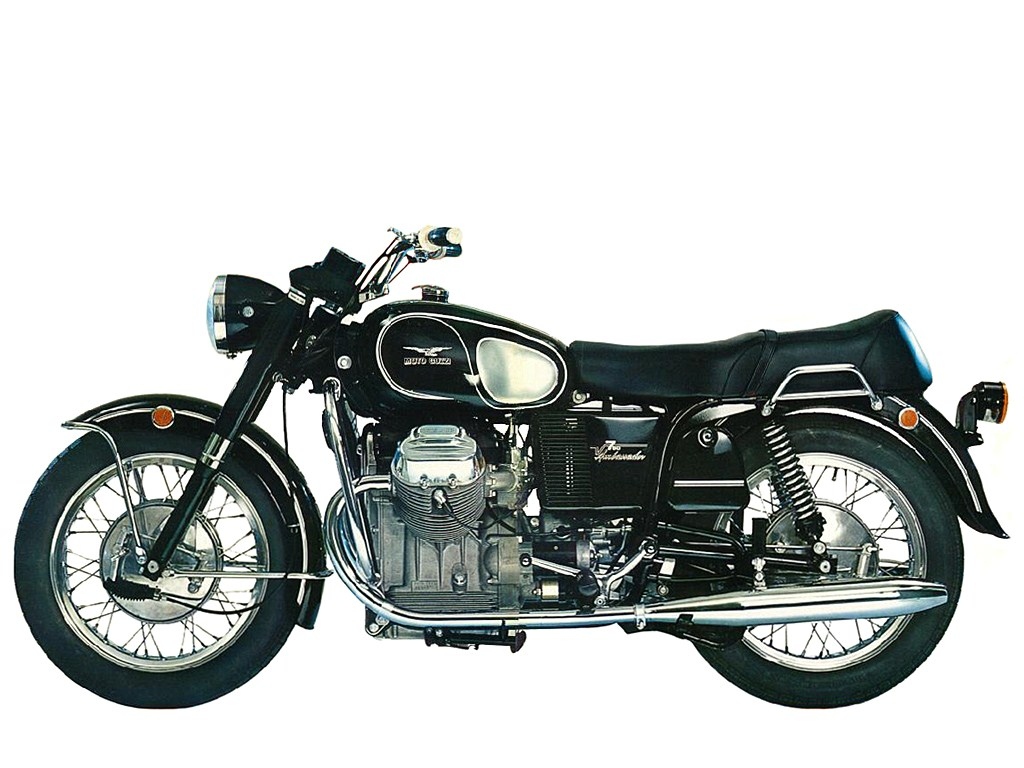
He had the Guzzi parked where we could walk all around it, which was considerate of him. His daughter had sent me some 30 photos while I was still in Seattle, so I thought I knew what to expect: the bike, vintage hard bags, a windshield, foot boards, running lights. In person, I saw that he'd added a trunk bag to it as well. On the clean-swept floor were arranged in a row these items:
-a set of oversized (950cc) resleeved cylinders and pistons
-a user's manual, (which are much more useful than the ones nowadays. Ones for old bikes actually give detailed instructions on how to set timing, etc.)
-a Premier manual, which is the shop manual for these bikes. (Premier is the importer. They wrote the service manual.)
-a copy of Guzziology.
Considering the overall asking price, it was an attractive spread.
However, the desert sun had oxidized the bike's paint, so instead of black, the tank and fenders were almost as gray as a Persian cat. The red and amber lenses of the turn signals were cataracted with scratches. The dash was scratched from the keys and faded like the fenders. The eagle logo was worn from the tank but the hand pin striping was still there. Mostly. I'd read someone describe these bikes as comfortable like "a favorite pair of old blue jeans." If that's the case, this pair was a little threadbare in places. Because of the broken transmission, the clutch lever was lashed to the handlebar with a bungee cord.
Upon closer inspection, the electricals were running rampant. Near the transmission, wires were undone from a threaded post, yet were clipped together with an alligator clip on a lead whose other end disappeared into the shadowy corners of the chassis. Oh my. Obviously it was a work-around solution. A solution to a problem, but not really a fix. Given the complexity of my plan, I got a sinking feeling about the whole thing. Elsewhere, I saw wires worn through their sheaths, and bunches of others had been braided into a kind of rope. Beneath a gummy spiral of uncoiling electrical tape, I saw how they'd all been soldered together.
That sinking feeling grew, but not necessarily because of the condition of the bike. Rare is the vintage bike that doesn't have questionable fixes dangling in plain sight. They're at least forty years old, which is a lot of time for one prior owner or another to take a shortcut or two when fixing a problem.
No, the sinking feeling was sitting heavy on my diaphragm because the bike needed Work--Work with a capital W. I had imagined a more pristine example, whereas I saw a full tear-down and rebuild in front of me.
Dreams, as they say, die hard. Mine was arrhythmic, but hadn't yet gone into full arrest.
Because internals can have unseeable or unhearable damage, buying a used internal combustion machine is a gamble you can't altogether calculate your way out of. All you can really do is inspect as much of the machine as you can from outside, maybe conduct a compression test or leak-down test, and draw conclusions about how it was treated overall. In the end, you've come up with a list of pros and cons to weigh against each other, but you know the list is incomplete. When all is said and done, you rolls the dice; you takes your chances.
The major weakness of the loops is the cylinders. Originally they were lined with chrome because chrome expands and cools close to the same rate as the metal around it. This allowed for closer tolerances when machining and better overall quality, then say, the iron-to-aluminum relationship between the bores and pistons of other motorcycles.
However, over time, the chrome flakes and falls bit by bit into the engine, where it scores bearings and clogs oil passages until the motor finally fails. (Or "...until the replace engine light come on," one Wild Guzzi member wrote.)
The solution that brings the most peace of mind is to replace both jugs with Nikasil cylinders, a compound of nickel and silicon carbide that's nearly bulletproof. Among others, Mercedes, BMW, Porsche, Ferrari, Maserati, and Chevrolet (ZR-1 Corvette) use them. The manufacturer Moto Guzzi uses for its Nikasil cylinders is Gilardoni, a neighbor of theirs in Lake Como. Every bike has its niggle, but like addressing the crankshaft bearing in Norton's Combat motor, replacing the cylinders of a loop are a must-do. The list of parts for a Gilardoni-Guzzi fix runs into the four figures. Those who learn this fact after buying a used loop recalculate the math of their purchase with a sigh of buyer's remorse.
Wyn had told me he'd had the cylinders redone, so when I knelt and inspected them, near the base of each was stamped Gilardoni, just as it should be. That right there made the asking price a deal. Also, he'd had the crankshaft balanced, and had the receipts for all the work and lists of parts from MG Cycle and Moto International even. The bike had been cared for. It was just tired and well used, was all. The tank chrome was good, which in my experience is somewhat rare. The crash bars were good, too. All the chrome looked good, save some battery acid on the exhaust, but the exhaust was original. My hopes buoyed and my list of pros just gained on my list of cons. But just a little.
The motor turned freely, but when we attempted a jump, there was a failure within the ignition system so it wouldn't even turn over. "It should run," Wyn said.
One rule of buying used motor vehicles is to not pay much at all for one that does not run. Some won't even consider a non-runner to begin with.
Another rule is to buy the nicest example of that model you can find.
So far, Wyn's bike hadn't satisfied either of these rules.
(As far as the second rule goes, I'd seen nicer loops, for sure. I just didn't agree with the pricing. In Seattle, people were asking too much for loops that still had their original bores.)
I had, however, some solutions. I'd been donating two nights a week of my time at a garage in Seattle that funds missionaries and orphanages by reconditioning and selling motorcycles. Because I'd given my time so freely, the owner said they would repaint the Guzzi tank for me and only charge me materials costs. Maybe I could include the fenders also. I had a free donor bike lined up, too.
All of these variable clouded the decision for me. At the end of the afternoon, Wyn's wife was calling to him from the kitchen, counting out the minutes until he had to have his next insulin shot. His energy had faded by then, so he'd taken a seat in a lawn chair at the entrance to the garage while I stood facing the bike, deliberating with folded arms and furrowed brow. He had a stick he was using as a cane and sat holding it like a scepter and staring across the valley. Occasionally he tapped and twisted the tip of it quietly on the floor. For maybe five minutes, that was the only sound in the room.
Before she got too close to zero, I thanked Wyn for all of his time. "This just isn't for me," I said. Disappointment hung in the air between us.
Hours later in the dark, I'd still be a long way from home, heading back to Phoenix in silence because out there in the scrub, the stationless radio scrolled ceaselessly. And that's what you get for chasing a mirage: time in the desert by yourself.
A least we'd build the pirate ship.

No comments:
Post a Comment