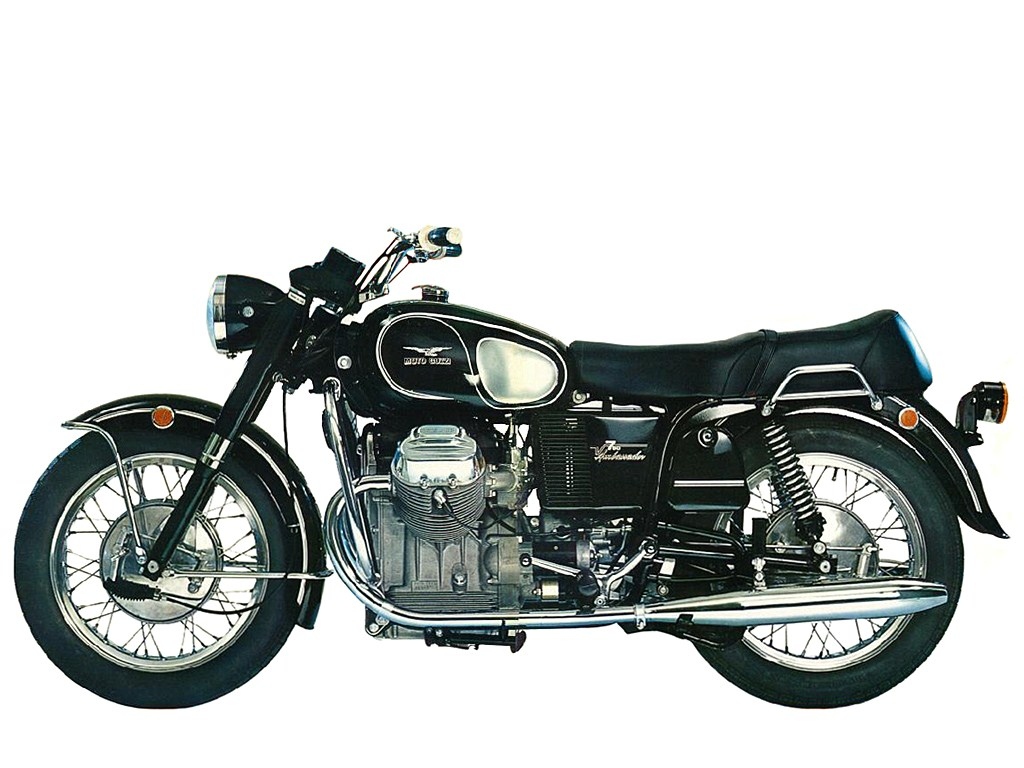
Since 1921, the Italian manufacturer Moto Guzzi has been producing motorcycles you've probably never heard of. Given the firm's history of accomplishments, this is somewhat hard to believe. In Grand Prix racing, a sport as passionately observed and simultaneously alien to Americans as bullfighting, Guzzi was a major player through the mid 20th century. Its palmares at the world's most famous and perhaps most dangerous motorcycle road race--the Isle of Man Tourist Trophy time trial--held annually just of the coast of England, alone is book-worthy. In 1926, Moto Guzzi rider Pietro Ghersi, who'd bettered most all of the British field by finishing the race in second place, was disqualified for using the incorrect spark plug in his machine. The resulting scandal became known as "The Guzzi Incident." Guzzi won the race nine years later. Not unoften, riders who grew restless with their British sponsors would then ride for the Italian firm.
In 1955, Moto Guzzi made motorcycling history by unveiling a 500cc, V8-engined machine for that year's Grand Prix season. Though it wasn't the V8 design that made the new machine special. The 8 had already been done. In 1907 American visionary Glenn Curtiss built such a motorcycle, yet his was 3500cc larger and 60mph less fast. (Again, that's 3500cc larger. Not 350.)
What made the Guzzi so special is the miniature scale of the parts. The entire motorcycle weighed only 99 pounds. With a top speed of 172 miles per hour, the Otto Cilindri's capabilities meant it wasn't years, but decades before its time. It was more space-race than circuit race.
Limits in the metallurgy of the time, however, made Guzzi's miniature powerhouse unreliable. Limits in tire and braking technology made it nearly impossible to ride. News of crashes often followed its race course appearances, including one on its maiden outing. In the end, the masterwork was parked because no one could be convinced to ride the machine that went faster than the speed of science. In the whole world, only two examples remain.
And Moto Guzzi has never had to cease production. Not war, not lack of funds, nor labor disputes, or any other of the reasons that have brought about the end to a motorcycle marque have made them shut down the milling machines and empty the factory floor. That fact makes them more enduring than every other motorcycle manufacturer except for Harley Davidson.
For years Moto Guzzis were the choice of police departments in Italy as well as here in the U.S. Mussolini posed on one for a publicity photo because in Italy, they are beloved. You'd think they'd be more well known than they are. Yet the stories from the firm's storied history don't get told that often.
And so their production numbers remain small. In the marketplace, its model line sits along the shoreline of the mainstream. The public seldom gives more than a glance. And why should it? Rather than staking a claim to any niche, they seem to be a distant runner-up in every category. Unlike the Japanese big four, Guzzi gathers little attention from high-profile competition, nor did it have the long-range marketing strategy and advanced manufacturing techniques that Honda in particular developed by the 60s. BMW has an unassailable reputation for engineering quality, and its cars advertise that achievement in suburban parking lots and chic avenues throughout the U.S. Look at how many people buy them. They must be good, is the idea. Honda, too, has found itself on the heavy end of that same tipping point, and so benefits from already having fleets of their products on the roads. Everyone knows Hondas are quality. Their bikes get respect for that reason alone.
While some Guzzis are quite attractive, many aren't known for being in-your-face sexy. Unfortunately, in the motorcycle world, that beauty-commodity has a price above rubies. On their contemporary bikes, their exhaust note for the most part sounds muted. Shaft drive bikes are as staid as LL Bean, and why does its engine stick out like that? Never mind that it shares the same cylinder cooling philosophy as BMW. What's considered smart engineering by the Germans, is thought of as an odd one-off when people see a Guzzi.
Add to that they're made overseas. To some, that makes all the difference.
Poor Guzzi. They're not even the bridesmaid of bikes. Rarely do magazines even feature one of them as the soon-to-be-slaughtered dark horse in a herd of comparison rides. At best, Guzzis are simply unknown, or maybe just unconsidered, or worst of all, dismissed.
When I'd see one, I'd hardly give it any notice. Big, clunky, tourer or cruiser bikes was what I saw them as. I dismissed them as another BMW or Harley wanna-be.
In Seattle, though, I started to see a different style of Guzzi. The company's early twin cylinder models, known as the "loop frames"because of their curvy elements of their frames, the nearly identical V7, Ambassador, and Eldorado of the late 60s through mid 70s caught my eye. Like a desirable car, or a popular color house paint, or or most anything really, once you first notice one, it seems like you start seeing them everywhere.
At VME meetings or at Backfire--two of Seattle's bike nights, I'd see maybe half a dozen loops throughout the evening and saw their two styles. The ex-police bikes, bought from auction, have wide handlebars that embody the company's open-winged eagle logo. When parked on their side stands, it's easy to imagine a black-booted officer in sunglasses and half helmet swinging a leg over them before ambling up to a motorist he's just pulled over. Those bikes have a swagger like Brando.
The civilian models are more clean cut. The main difference is a dual seat, a narrower handlebar, the addition of a tachometer, foot pegs as opposed to footboards, and smaller, Lucas turn signals. These changes give the bike a more stately appearance. Both are parade bikes; the difference being the parade is for the civilian model and the police bikes are the bodyguards.
Like all vintage bikes, they are smaller and lower than today's swollen cruisers. However, they still covered an expanse of parking space. With their large, semi-valanced fenders, and long wheelbase, authority seemed to emanate from them; I see why they were successful as police bikes. In a word, I'd call it presence, which is both a matter of taste and rare.
Mostly they looked older than the were. I'd never seen anything like them this side of an Indian Scout.
At those bike nights I'd watch from a distance as the owners arrived. I'd imagine myself as them, the way people in traffic study me on my Ducati or my Triumphs and imagine. Could I picture myself on a bike like that? Would I want to be that guy? I'd keep my distance while they cut the engine, climbed off and unbuckled their helmet and watch as they got a sense of their bearings and agenda. Only if they seemed unhurried then would I approach and initiate a conversation. "How do you like that bike?" usually got the conversation rolling.
Mechanically, they operate as if fashioned entirely with hammers and chisels. Press the starter button and the starter solenoid activates the starter with a clack as loud a rat trap. Effort necessary to turn the heavy flywheel delivers a high-amp whrring sound like a car's ignition, which it pretty much has. First they shake from side to side like bull in a gate, then they settle into a clackity pulse more mechanical and uniform than a Harley. In sum, there is nothing delicate about the industrial and overbuilt sound of the loop.
I was smitten by them. Like the object of any crush, the as-yet-unplumbed depths of its mysteries drew me right in.
[Aside: The Vanguard clothing company uses them in their image-driven ads (youtube) but dubs in the exhaust note of a Harley.]
There are a well-known handful of motorcycle shops and restorers in the U.S. that actively support Moto Guzzi motorcycles from this period. Harpers out of Greenwood, Missouri, Cycle Garden out of Huntington Beach, CA, and MG Cycle out of Albany, WI.
And Moto International, in Seattle.
Additionally, there are two source books for these bikes--one, titled "Guzziology" was written by Dave Richardson, the middle-aged owner of Moto International. Unavailable at retail book stores, and priced at $100 on Amazon for a used copy, the book seemed somewhat rare. One Saturday before Seattle traffic made the 10-mile trip a two-hour one, I drove to Moto International so I could see a copy for myself.
The book is a 25 chapter collection of what he's learned about these machines in his 30 years of involvement with them. Intended as a supplement to the shop manual, and designed to lay open on a shop bench, it details maladies and their fixes, and affordable work-arounds, not just "go-to-dealer-and-buy-official-part" advice. Some 500 pages pages long, and searchable by topic and subdivided model, it is a book for the industrious type and is considered The Bible for these bikes. And like the Cryptonomycon, its mass and diversity across the model lines and decades makes me doubt that anyone has read it in its entirety. "In memory of my father, who through his mechanical aptitude as a machinist and his thriftiness as a Scotsman, taught me to always try to fix something myself before paying someone else," writes Richardson in the book's preface. Upon reading that sentence my bones tingled in accord with that philosophy and my soul said, "This is for you."
The parts guy and the mechanics were all busy, so with book in hand, I started talking to a sales guy in old jeans and an unironed button down shirt. The showroom was customerless, so he invited me to sit so he could show me some pictures of loops he'd taken the week prior from a Guzzi rally at the factory in Italy. (Later I would realize the photos were from the company's 90th birthday celebration.) A gray-faced dog lay at our feet and barked occasionally for no reason I could see.
He pushed back in his chair and listened as I told him I'd gone to check out a police bike on craigslist in Portland the weekend prior. Soon he was squinting at my phone's tiny screen, reviewing the pictures I'd snapped. Loop-wise, I called it research, but deep down inside, I knew I would buy one sooner rather than later. The hunt for one seemed to have unofficially begun. And as collector-types know, that's a big part of where the thrill lies. We discussed the merits of a flawless repaint verses a dinged and scratched original, of purported speed wobbles above 80mph, and of being able to fix loops with only three tools.
"I've got the Guzzi bug," I concluded aloud, unnecessarily.
In reply, he nodded at the copy of Guzziology on the table between us and said, "It sounds like this book would be a good resource for you to have."
I told him how much I identified with the preface that "...Dave Richardson..." had written, and I looked around the shop for "Dave," whoever he was. The salesman's expression changed and after a pause, he said, "I'm Dave." We'd spoken for 20 minutes and he never let on to who he was because he never really talked about himself or the depths of his knowledge. I simply never would have guessed.
In my copy of Guzziology, he wrote, "To Andy, Here's to Good Guzzis."
The other book is "Moto Guzzi Big Twins," written by Greg Field, who is also from Seattle and is in the same vintage motorcycle club as I am. Early in the summer, when I started asking around the club and at the vintage engine machine shop where I sometimes get advice, his name kept coming up. I met Greg a few months ago in a parking lot before the club meeting. When he pulled in, I waited for him to get parked and oriented, then introduced myself. A number of big guys with beards were soon around us.
Of course I had a number of questions. At that point, many of them were basic, and though the others probably knew the answers, they stood quietly and let Greg do the talking for them all. At some of his comments they nodded as if the information was new knowledge to them, too.
Unlike Dave, Greg draws attention. With a shaved head and a handlebar mustache, and standing over six feet tall, he looms above whatever crowd that I since learned usually surrounds him. I saw him at a meeting before I knew who he was, but his "Moto F---in' Guzzi" t-shirt was arresting. As are the pair of brass knuckles that serves as cylinder head guards on his bike. (He rides a police bike--no surprise at that choice.) However, he is most definitely a skilled machinist, a thoughtful engineer, and an independent thinker who can walk the walk, not just talk the talk and drink beer. People seem to want to be with him.
Guzzi made a number of engine designs over the years, but the loop frames have the motor arrangement they are best known for: the transverse V-twin, like a Harley turned sideways or a BMW saluting, Guzzis are like the latter in that, as I said before, they also have a shaft drive. Odd bikes, really, they are more car-like than motorcycle-like and are compared to tractors because of their overbuilt ruggedness. In fact, the word "agricultural' is used a lot when describing them," but I've yet to read that in any official history.
But because they're Italian, for better or worse, they have that something extra.
I wrote earlier that Guzzis aren't eye candy, but the loops have somewhat changed my thinking on that. When compared to other Italian bikes, they're the brunette in the sea of blonds. You don't necessarily notice her when you first walk into the room, but when you get past the make-up and the bright clothes of the others, the loop comes to the fore as a classic beauty. And those are wonderful moments of glowing discovery.
Or maybe I'm just into weird bikes these days.
They're the bike people notice and admire, but not many know what it is, really. There are, however, a surprising number of them in Seattle. Where else could I see six at a time at a bike night? I'd say it's due to the influence of Dave and Greg. I also think that Dave's understated personality and Greg's aura represent the brand to a T. Guzzis are easy to miss, but once you see them, they stick out in a crowd. To me, Dave and Greg's personalities are two sides of the same coin; they're ambassadors of Ambassadors.
I joined the "wild goose chase" message board and Yahoo's "loop list," group, and as I learned more, Moto International, Guzziology, and Greg ("GF" to the initiated) were mentioned almost daily by owners all over the country. As in all esoteric pursuits, the community of those involved is an intimate one. I seemed to have found myself in one of its hubs.
However, I'm writing this from Phoenix, AZ.
I came to this desert place in order to drive to the even more desert place of Las Cruces, NM. There, in the bone dry garage of an aging diabetic who is unable to ride anymore, I knew had sat for some time a '72 Eldorado, complete, nearly entirely stock, with matching, vintage hard bags and windscreen.
It was also heavily discounted due to having a broken transmission. Upon hearing about the bike, I called the owner and in his quiet drawl, he explained to me its symptoms. "I rode it down the street... an heard a clunk at the stop sign...I was unable to get it outta first gear after that... so I turned it around and rode it right back here. Where it has sat. Ever. Since."
Research told me it was probably the shift return spring. In Guzziology, chapter 10, Richardson writes, "Up until the late 70s, these transmissions were known for broken shift return springs...This is a cheap enough part [$10.00] and there are enough of them available that I recommend replacing it any time the transmission is open." I thought, to myself, I can fix that. Never mind that I'd never really worked on a machine like a Guzzi.
The guys at Moto International and I talked it over one afternoon. Exploded diagrams from the parts manual were photocopied. Tips on disassembly and reassembly were shared. Additional seals and gaskets were recommended with the assurance that I could return anything I didn't use. Like a road map in a convertible, the dream of an epic adventure unfolded before I could stop it.

No comments:
Post a Comment